Today’s the last day of 2007, the perfect time to take one last look back at the year that was and arbitrarily declare which were the best graphic novels of the year.
Why? Because it’s the law.
For the purpose of my best of ’07 list, I’m using the same definition of “graphic novel” and the same criteria for the purposes of this list that I did last year—any work of long form sequential art published in 2007 (be they collections of comics strips, collections of comic books, collections of short stories from various sources and original graphic novels, regardless of what year the work collected was originally created). Additionally, I’m focusing on works that could be read and enjoyed by themselves, which in some cases eliminates 2007 volumes in series.
And, as a final caveat, while I read a lot of comics and graphic novels every week, obviously I didn’t read everything that was published in the year 2007, so this is more a top list of books I personally read rather than of every book published this year. But “The Best Graphic Novels That Were Published in 2007 That Caleb Happened To Read by December 31st” just isn’t as snappy a title.
Here’s what I’ve decided are my top ten:
1.) Robot Dreams (First Second), by Sara Varon A sweet story about making and losing friends populated by darling anthropomorphic characters that is actually an achingly bittersweet meditation on the most human of experiences—losing someone you love due not to tragedy or death, but circumstance and time. It’s a rare work—of any medium—that can break and warm your heart at the same time. (Note: I originally identified the publisher as AdHouse Books; I regret the error. For great '07 AdHouse releases this year, check out Joey Weiser's fun all-ages adventure The Ride Home and Jamie Tanner's ultra-weird The Aviary, and superior floppies Johnny Hiro and Skyscrapers of the Midwest).
2.) The Salon (St. Martin’s Griffin), by Nick Bertozzi In my original review, I called this “a masterpiece of a graphic novel,” and my opinion of it hasn’t diminished since.
3.) Laika (First Second), by Nick Abadzis The Cold War space race as seen from an unusual point of view. It’s not just that Abadzis looks at the Russian rather than American program, but that he gets inside his characters’ heads, all of them, and considering one of them is the titular dog, the first Earthling in space. It’s not easy trying to tell a story from the point of view of an animal, but Abadzis succeeds wildly, relying on the essential nature of comics to present the brave little dog’s thoughts as mostly-wordless dreams and memories. It’s a very convincing conveyance of how a dog might think. And Laika is but one of the interesting characters in this fictionalized version of a real-life epic story.
4.) Stagger Lee (Image Comics), by Derek McCulloch and Shepherd Hendrix An amazing mixture of fiction and non-fiction, this graphic novel dramatizes a version of the Stagger Lee legend, the inspiration for what seem like a million different songs, while also engaging in musical and cultural archaeology, drawing interesting and unexpected connections.
5.) Crécy (Avatar/Apparrat), by Warren Ellis and Raulo Caceres Certainly the best thing Ellis has written this year, and maybe, just maybe the best thing he’s ever written. Considering the fact that he writes several thousand new comics every week (I’m estimating), that’s really saying something. It’s educational, entertaining and important.
6.) Doctor 13: Architecture & Morality Architecture & Morality (DC Comics), by Brian Azzarello and Cliff Chiang The unbelievably good story of a professional cynic and a band of the least-believable comic book concepts in DC’s publishing history team up for a hilarious adventure, meditation on the modern comics industry and creator’s manifesto, all rolled up into one beautifully drawn package boasting a joke or ten in every panel.
7.) Exit Wounds (Drawn & Quarterly), by Rutu Modan A subtle exploration of personal and national identity, played out as a young Israeli man’s search for his estranged father and his father’s young lover, whom he may be starting to fall in love with a little bit himself. Great story, great art, great colors, great book design—Drawn and Quarterly had a hell of a year this year, and this may just be the crown jewel in their ’07 output. This, or perhaps Shortcomings. Speaking of which…
8.) Shortcomings (Drawn & Quarterly), Adrian Tomine Tomine fills me with hatred, he’s so damn good. The bastard.
9.) Tekkonkinkreet: Black & White (Viz Media), by Taiyo Matsumoto An oversized, one-volume collection of the manga series about two feral street kids who battle yakuza and gaijin investors for the fate of Treasure Town, a city apparently devoid of straight lines, in which an odd assortment of wild animals can be drawn into the background of any panel. It’s kind of like Batman, if Batman were two little kids, one of whom had a severe developmental problem and an affinity for funny hats. Matsumoto’s queasy urban environments and strong characters make for an incredibly engrossing read, of the sort it’s hard to stop once you start, and every character’s arc is of great interest, no matter how despicable they seem when you first meet them.
10.) 52 Vols. 1-4 (DC Comics), by A Small Army of Creators If anything on this list is likely to get me laughed loudly at, I suppose it’s this. And I have gone back and forth with whether what is, on its face, just a superhero soap opera deserves to be up here in the top ten, or down there on the lists of candidates for top ten spot-age. But ultimately, the 52-part weekly series, which was collected into four different trades that were released throughout 2007, belongs up here. I’ve always believed pretty firmly that the thing that distinguishes the very best comics are the ones that do things that can only be done in comics (Regarding comics criticism specifically, but this principle holds true for works in every medium; the best films are the films that do what only films can, the best plays, the best prose novels, etc.). Great characters, great dialogue, great stories, even great art—these are things you can find in other media as well. But 52 exploited the shared setting and decades-long fictional history of the DCU—something built up over some 70 years by hundreds of different writers, artists and editors—to tell a massive story that could have only been told in a comic book series. For its scale and ambition alone, this is a remarkable comic book. But when all is said and done, it was more than just that scale and ambition, or the unusual format, that earns 52 a spot up here—it also had all t hose things you look for in comics. It certainly wasn’t without its problems—obviously the art wasn’t the best, and there were problems with the narrative structure and point of view—but it’s still by far one of the most amazing comics that was published in ’07, even in this trade form, which I originally thought the story wouldn’t take to.
Throughout the year, every time I read a really good comic I thought might conceivably be a candidate for a future Best of the Year notation, I added it to a list. Below are all of the books that were on that list when I sat down to pick the top ten.
I don’t think these necessarily constitute the next best 22 books of the year, and looking at them now on December 31st, it’s clear some of them weren’t ever seriously in the running for the top ten, but may have seemed like it while I was subjected to the high of having just put down a comic book I really enjoyed. Anyway, I thought it might offer a different way of rounding up some of the more notable books of the year, even if, in some cases,uch of tthat noteworthiness seems to have dissipated between the time I first read them and now.
All-Star Superman Vol. 1 (DC Comics), by Grant Morrison and Frank Quitely Put as simply as I can put it, this is probably the best superhero comic there is at the moment, and probably one of the best of any moment ever.
Aya, (Drawn & Quarterly), by Marguerite Abouet and Clement Oubrerie I called this “easily the first absolute must-read of 2007,” so I hope everyone’s read it by now. A romantic dramedy set in the capital city of the west African country of The Ivory Coast in the late ‘70s, it’s a rare chance to see a story about Africa that isn’t about genocide, AIDS or safaris.
Black Metal Vol. 1 (Oni Press) Perhaps the most fun I’ve had reading a comic book this year. The only serious competition I can think of off the top of my head, in fact, was from Scott Pilgrim Vol. 4 and Yotsuba&!.
Dogs and Water (Drawn & Quarterly), by Anders Nilsen See what I mean about the year D+Q had? Here’s another of their releases. Nilsen’s post-apocalyptic existential melodrama is a beauty to behold. Occasionally unsettling—even somewhat irritating—it’s ultimately massively rewarding.
Elk’s Run (Villard), by Joshua Hale Dialkov, Noel Tuazon and Scott A. Keating A “coming of age thriller” about a small-town utopia that becomes a dystopia in the space of less than a generation. This is another genre piece that I don’t think manages to transcend that genre, but as a thriller with a neat hook and strong characters, it works quite well.
Empowered Vol. 1 (Dark Horse Comics) by Adam Warren Warren deserves a medal for turning out a superhero comic that manages to objectify its heroine and fetishize all of the genre elements, and yet still manage to do it without sacrificing the quality of the art, writing and humor, without insulting the reader and, most admirably, doing it in the context of an admirably healthy and honest relationship. Oh, and it’s in a book geared specifically at an audience who would like to see a barely dressed superheroine having sex and not, you know, for a general audience featuring a corporate owned pop culture icon.
Essex County Vol. 1: Tales From the Farm (Top Shelf Comix), by Jeff Lemire Despite the enthusiasm I expressed for the fact that this was labeled “Vol. 1,” promising at least one more volume, I still haven’t gotten around to reading the since-released Volume 2. This first volume is an elegiac short story with pretty incredible, versatile artwork that manages to do most of the heavy-lifting when it comes to telling the story. This is one of several books on this list that is a veritable how-to lesson in comics creation.
Fafhrd and the Gray Mouser (Dark Horse), by Howard Chaykin and Mike Mignola That this is a sword and sorcery novel adaptation by Chaykin and Mignola is really all you need to know about what makes this a book worth a comics reader’s time. Dark Horse’s new collection of this 1991 series captures Mignola still transitioning to the style his fans will recognize from his more recent Hellboy work, has some wonderfully fun characters to hang around, and boasts a scene in which a dude totally has a sword fight with an octopus that has eight swords! That may have been the single coolest scene I’ve read in a comic book this year. Here it is, in all it’s tentacle-slicing glory.
The Grave Robber’s Daughter (Fantagraphics), by Richard Sala Looking back from December, this is one of several books that doesn’t rally belong here, but, it’s release early in the year landed it in my “To Think About For Best of ’07 List” file. In my original review, I described the plot like this: “Girl detective Judy Drood is like a buxom Veronica Mars with Nancy Drew's fashion sense, the foul mouth of a sailor and the brawling skills of a prize-fighter. Sala's spooky adventure opens with Judy's car breaking down outside the secluded town of Obidiah's Glen, now populated entirely by asshole teenagers, scary clowns and a single little girl. Judy starts out simply looking for a phone, but soon has to fight her way through undead clowns and hard-partying teens to crack the case.” I had previously counted the ways in which I loved Judy Drood in this post.
Houdini: The Handcuff King (Hyperion), by Jason Lutes and Nick Bertozzi Come on Bertozzi; give someone else a chance, huh?
Incredible Change-Bots (Top Shelf), by Jeffrey Brown What kept this out of the top ten was the fact that if you don’t share the necessary set of experiences that inspired it—specifically, watching a certain cartoon and playing with a certain line of toys in the ‘80s—it’s going to seem more silly than brilliant. If you do share those experiences with Brown, however, then you’re in for an amazing reading experience. I wish more of the nostalgia-fueled comics in the market these days had this sort of creative version of nostalgia driving them.
James Sturm’s America: God, Gold and Golems (Drawn and Quarterly), By James Sturm Three formative tales of the making of America, from three different periods of time. All three are somewhat dark, but it’s not an oppressive darkness. These are tales of the past, after all, and while the ignorance, greed, violence and hatred they illustrate went into the construction of this country and its spirit, they also show the impact that normal, everyday people truly have. There’s more to history than wars and presidents and, in fact, those things may not even be all that important, really. I loathe the title of this book, incidentally.
King-Cat Classix (Drawn & Quarterly), by John Porcellino One of the pioneers of auto-bio comics gets a massive 380-page collection of his zines and mini-comics, covering most of his almost twenty-year-long career. The beauty of this collection is that it’s big enough that you can see Porcellino’s work change before your eyes, as he becomes a wittier and wiser writer, and a sharper, more elegant artist, with each thirty pages or so.
King City Vol. 1 (Tokyopop), by Brandon Graham I first became aware of Graham’s work after reading Escalator, a collection of shorter pieces from the writer/artist in which you can see him feeling his way towards what I think of as a sort of world fusion style, mixing elements of manga, European comics, American comics and other types of art in a storytelling style that’s the best of all worlds. It’s a style Paul Pope, Corey S. Lewis, Bryan Lee O’Malley, James Stokoe and a few others are working in to various degrees, although, obviously, there’s a great deal of difference in their finished products. Anyway, this is Graham’s first long-form work, a manga-like digest about the titular city and its interesting inhabitants. And it’s a tour de force of design. I tried to explain the awesomeness of King City in this post.
The Living and the Dead (Fantagraphics), by Jason Before reading this, I was so goddam sick of zombie comics that if I never read another one for my whole life, I probably would have been set. And yet despite this being a comic about zombies, as it turns out a Jason comic about zombies is an entirely different type of zombie comic. Confession: I still haven’t read I Killed Adolf Hitler. It may be even better than this one; I honestly don’t know.
The Professor’s Daughter (First Second), By Joann Sfar and Emmanuel Guibert I’m getting awfully sick of reviewing books by Sfar and Guibert, as it gets a little tedious trying to think of new ways to compliment the same damn creators for a great new book every month or two. I’m not getting sick of reading their books one bit, though. The two reverse their normal collaboration duties here, for a sort of romantic comedy turning on the civil rights of mummies in Victorian England.
Red Eye, Black Eye (Alternative Comics), by K. Thor Jensen A comic book Kerouac travels the country by Greyhound bus, visiting friends and internet acquaintances as he searches for an adventure that will land him a black eye. Part travelogue, part anthology of biographical anecdotes collected from others and part auto-bio drama, it makes for a fascinating read. There’s a preview here, and I tried to figure out the specifics of his Columbus visit, and got some expert help in the comments section, in this post.
Spent (Drawn & Quarterly), by Joe Matt A creepy, possibly psycho chronic masturbator, porn addict cartoonist alienates his cartoonists friends while going to insane lengths to avoid spending money and interacting with his housemates. In his free time, he focuses on creating the ultimate pornographic mix tape. Sad, hilarious and more than a little distressing, for the glimpses of yourself you may see in Matt.
Terr’ble Thompson (Fantagraphics), by Gene Deitch This collection of the short-lived 1950’s comic strip about a young boy who was the real hero of history, serving as a sort of factotum solving the various problems of history’s notables. Deitch’s cartooning is top-notch, and doesn’t look the least bit dated.
Wire Mothers: Harry Harlow and the Science of Love (G.T. Labs), by Jim Ottaviani and Dylan Meconis A fictionalized telling of the true story of the scientist who proved love was real in a series of experiments. Real enough to be accepted by the scientific community, anyway.
The World Below (Dark Horse), by Paul Chadwick In introductory material presented with this new collection of a short-lived action adventure series from the man who brought us Concrete, Chadwick talks about how any TV producers in the reading audience might like a story that’s just like Lost but different. He sells his brilliant if hardly transcendental genre story way too short. Mixing elements of British sci-fi comics and old-school pulp prose sci-fi, Chadwick sends an expert group of explorer/soldiers into a bizarre underground land, one that he populates with animals, monsters and machinery among the most alien I’ve ever encountered in comics. The imagination that must have went into that world-building is impressive as all hell; Chadwick invented creatures that operated so far outside of our normal understanding of science that a reader could feel just as lost as his protagonists. You’ve literally never seen anything like the world in The World Below.
Yotsuba&! Vols. 4-5 (ADV Manga), Kiyohiko Azuma Each chapter of this manga about a precocious toddler is a complete story unto itself, although the jokes get funnier and funnier the more chapters you read. At this point, the sight of Yotsuba alone is enough to make me crack a smile.
Monday, December 31, 2007


The Worst Lines of 2007

The beauty of the comics medium is that it is one that marries the written word and the drawn image, and the ratio between the two can always be adjusted, so that one can always do a little more work than the other when it comes to telling a story.
In other words, lines like those below could easily be avoided—and should have been. Here are the most laugh-out-loud terrible sentences, some originally delivered in dialogue others in narration, by some of the industry's most popular and successful writers this year...
“Now close your eyes, gentlemen. This might hurt.”
—Mark Millar, Civil War #6
“He’s going to die because that’s what people do. It’s humanity’s shared super-power. We die.”
—Greg Rucka and friends, 52 #36
“You’re the first person ever…to get a second chance… to make a first impression.”
—Paul Jenkins, Civil War: The Return #1
"Just because you can fly-- --doesn't mean you're not in a cage"
—Brad Meltzer, Justice League of America #7
“Nobody would want to see what I saw. Don’t you get it? It was-- The Death of Captain America.”
—Jeph Loeb, Fallen Son—The Death of Captain America #1
“I don’t know who you are, lady-- --but you’ve just awoken the hawk!”
—Gail Simone, Birds of Prey #105
“Tune your ear to the frequency of despair, and cross reference by the longitude and latitude of a heart in agony.
Listen.
Listen.”
—J. Michael Straczynski, Amazing Spider-Man #544
“Those days gave way to more days for these heroes…hard traveled.”
—Judd Winick, Green Arrow/Black Canary Wedding Special #1
Sunday, December 30, 2007
Because No One Demanded It: The Batman's Christmas List Post-Mortem
As I did after the last bad joke and drawing theme month here on EDILW, I thought I’d do a sort of post-mortem to share some of what I learned. Also, it allows for an easy, totally phoned-in post requiring no real original thought, perfect for this between holiday week, during which most of the comics blogosphere seems to have gone dark.
Spending a couple weeks drawing superhero costumes over and over is actually a pretty interesting way to relate to them, giving one a better appreciation for how the artists one might complain about online all the time approach their work.
I found myself liking some costumes I’d previously hated, and hating other less than I used to, and appreciating details I’d never noticed before. Like just how much detail is in Catwoman’s current costume, for example, or how much Metamorpho has changed since the ‘60s.
I also found myself respecting the pros a lot more. I mean, I think Ed Benes is a horrible comic book artist, and a terrible storyteller, but I do appreciate the fact that he can draw the same faces and bodies over and over (the same exact faces and body types over and over) kind of admirable. That’s a skill in the cartoonist’s toolbox that I’ve never been able to master (which is part of the reason I draw myself all the time…it’s not just because I’m vain, but because I’m easy visual reference, and want to eventually be able to draw at least one character consistent from image to image). Like, just getting Batman’s ears the same length in different images (or both his ears the same length in the same image), or keeping the heights of two characters consistent form panel to panel is really freaking hard.
So Benes may be terrible compared to most other professional comics artists…he’s still a good draftsman, and has basic cartooning skills that are really hard to master.
Anyway, before I get into random observation mode, I thought I’d share some behind the scenes stuff with you because, well, remember what I said about phoning a post in?
I draw these all on index cards, as they are about 75 cents for 120 cards or something like that, and the cards form natural panels, so I can try to keep everything the same size for when the elves in the computer do whatever they do when they take something form the public library’s scanner and put it on my blog. (Close-ups are generally half an index card).
When I’m writing them, though, they’re a mixture of very vague drawings and indecipherable handwriting, which I developed during my time as a newspaper reporter. It’s so hard to read that even I can’t make it out. In a few months, I will likely have no idea what it says. But while it’s relatively fresh in my mind, I can remember writing it, and therefore am able to read it.
So, here’s what they look like when I first write them down. This is the page on which I wrote the Superman and Flash ones:

My house is full of pages and pages of things like this, illegible first drafts of comics and graphic novels. If I die tomorrow, whoever has the unfortunate job of dealing with my belongings is going to find folders and boxes crammed with these types of scribbled up pages that I myself can just barely make out.
Here’s another, featuring two I didn’t use. The top one was Oracle, the bottom one was the beginning of the Vixen one, which I scrapped:

Here’s something else I ended up not pursuing, Martian Santahunter:

And finally, when I realized I wouldn’t be able to draw Pete Woods’ Bat-Santa, I decided to go with a Christmas-colored version of the Bat-suit I’d been drawing all month, but wasn’t sure about how to color it, red and white, or red white and green.


I’m still not sure the red and white was best. Like, Batman’s normal costume is black and gray with a little bit of yellow (the utility belt). Maybe Bat-Sanata shoulda been red and white, with a green utility belt.
Now, on to the eight random thoughts on the JLA and Outsiders I had while drawing them on index cards…
1.) Vixen: When I planned these out, I was originally planning to do the whole month of December, which meant 31 of ‘em. Then I realized there was no point of doing them after Christmas, because why would Batman still be giving Christmas presents afterwards? And surely we would all be sick of Christmas by then anyway, right? So that knocked it down to 23-25 or so.
I was thinking I’d do everyone that was on one of Batman’s two teams, plus his sidekicks/allies, like Robin, Nightwing, Oracle, Commissioner Gordon and Alfred. But I axed all of those not on one of his two teams because none of them were the least bit funny (and considering how unfunny the ones I did post were, that’s really saying something).
Anyway, it wasn’t until I had drawn almost all of them and was halfway through posting them that I suddenly remembered that Vixen was on the Justice League again.
Does this mean I have a pretty bad memory, or that Vixen has had pretty much nothing to do in JLoA so far?
Or a little bit of both?
In the first arc, she really just came out of left field at the end, not really teaming up with either of the factions of heroes that would ultimately come together to form Metlzer’s League. The only thing I remember her doing in “Lightning Saga” was saying she was borrowing a cheetah’s speed to keep pace with The Flash (explained in the next story, I understand), and then I dropped it until McDuffie took over.
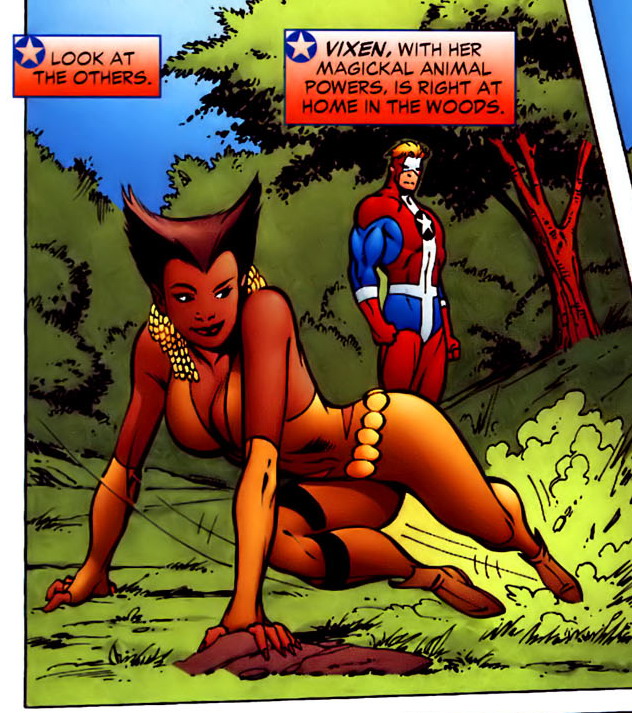
I had a reeaalllly hard time thinking of a Vixen joke; with the exception of Red Tornado, for whom I did two and settled on the second one, Vixen’s the only character I did, like, drafts of. The final one was the fourth idea I came up with, the first three being much, much, much worse (One involved her trying to suck bee powers out of Red Bee’s partner Michael though; I just really love drawing bees).
Anyway, I do like Vixen being on the JLA again. She’s a really good character for the book, because she works best in team settings, I think, and it’s nice to have characters from each discernible era involved with the book.
And I kinda like her current look. I never cared for the Wolverine/Beast-esque hair shaped like animal ears that she sported during the Detroit Era. I did like the dreadlocks she was rocking off-and-on during the period between Identity Crisis and Infinite Crisis, but the current short hairstyle (or the more slick version she had on JLU) probably make more sense for a model, as it would more easily allow her to wear hats and wigs than her long locks did.
I do kinda wish she’d get a mask similar to the one she wore in her original Cancelled Comics Cavalcade costume at some point though.
2.) Diversity: The League is the most diverse it’s ever been, and The Outsiders are also very diverse for a DCU super-team.
As of “Unlimited” and the first two issues of Batman and the Outsiders, here’s how things were looking, regarding gender and race on the two teams:
Justice League
4 white men (Batman, Red Arrow, Hal Jordan and Geo-Force)
3 black men (Black Lighting, John Stewart, Firestorm)
1 alien that just so happens to look like a white man (Superman)
2 white women (Hawkgirl, Black Canary)
1 black woman (Vixen)
1 magical golem who looks like a white woman (Wonder Woman)
1 red android whose secret identity used to be a white man, and who inhabited a white man’s body for a few issues there
The Outsiders
1 white man (Batman)
2 white women (Catwoman, Grace)
1 black woman (Thunder)
1 Asian woman (Katana)
1 half-Asian woman (Batgirl)
1 white/purple/orange/brown/silver man who used to be a caucasian guy (Metamorpho)
1 green Martian
Regarding sexuality, everyone on the League is straight. Batman and Wonder Woman can be argued about to differing degrees of seriousness, but Batman’s always done it with and dated ladies, and Wonder Woman’s only dated men. I understand there are some arguments over whether she’s a virgin or not. Let’s not get into it. Anyway, they’re all straight as far as we know.
In the Outsiders, there are two lesbians (Thunder and Grace), and everyone else seems to be straight (Batgirl isn’t sexually active; she’s kissed three boys and no girls, though).
Could the teams be more diverse? Sure, I suppose. I mean, the thing about diversity is it could almost always be more diverse, you know?
But the League is probably as diverse as it’s ever been. With Stewart and Firestorm II joining during “Unlimited,” there are now five black folks on the League at the same time. And with Black Canary, Hawkgirl and Vixen on the team, there are now four women. Considering Wonder Woman has been pretty much the only woman since the Morrison/Porter relaunch (Oracle, Big Barda, Faith and a few others joining for more brief stints during that time, of course), I think that’s pretty significant.
Should there be a hero of Hispanic on the team now? Or an Asian hero? Or a Native American? Or a gay person? Or a person with a physical disability? Looking around DC’s hero pool, I don’t know how much more diverse the League could get until some new heroes are created.
I can’t think of a single Hispanic hero who would work on the League at the moment; I know there are some out there, but none that have served on the League and/or seem iconic enough to be there at the moment.
As for Asian heroes, Dr. Light II is the only one that springs to mind, and I think she’s unfortunately sullied by her namesake’s retcon. She really, really, reeeaaaalllly needs a new codename. It’s only logical, you know? In the real world, if you’re name was, say, O.J. Simpson, chances are you would have started going by Othniel J. Simpson or whatever after the other version of your name became synonymous with that guy who may or may not have totally killed his wife, you know? If you found out your totally voluntary codename was the same as a guy who totally raped a colleague, why on earth would you keep using it?
Katana would be a possibility, even though she’s not quite iconic. Problem is, the League is pretty lousy with Outsiders right now, just as its lousy with people who have her exact same skill set that Tatsu boasts (beating people up with their bare hands).
That’s all I can think of at the moment. Again, most of the promising Asian heroes are too new. The current Atom could work on the strength of his predecessor’s place in the League, and the fact that he doesn’t belong on any of the other teams anymore (he’s not really a Golden Age legacy except on a technicality so he doesn’t belong on the JSA, he’s not a teenager so he doesn’t belong on the Titans, he’s not an outsider so he doesn’t belong on the Outsiders).
For Native American heroes, I thought Manitou Raven was awesome, filling both the magic guy role and the Apache Chief legacy. Like Black Vulcan’s history with the League via Superfriends kind of grandfathers Black Lightning in, I think Apache Chief’s role on the cartoons grandfathers in any Native Americans who can grow gigantic by saying “Inukchuk!” Sadly, he kinda sorta died, to be replaced by Manitou Dawn, who’s a bit less interesting.
The only openly gay hero to have been on the League, or to approach the popularity/power/icon status necessary to be on the league is Obsidian, and he’s in the Justice Society, which is a better fit for him anyway, given the book he was created for and his parentage. The Question II and Batwoman both seem too street-level, particularly at a time when the League already has Batman, Black Canary, an Arrow and Hawkgirl.
And physical disability? Oracle, naturally. Oracle should always be on the League. I think it’s ridiculous that she’s ever not on the League, since her close relationship with pretty much every hero on the team anyway always makes her a sort of de facto member. Why not give the lady a gold key, certificate and occasional nod in the damn roll calls, you know?
3.) Katana: I really, really, really liked Katana’s all red costume and short hair in the first two issues of the new Batman and The Outsiders. Poor Katana has had some really terrible costumes over the years, from her primary-colored samurai get-up to that horrible right-breast-as-Japan’s-rising-sun look (Which Judomaster II has taken over in the pages of JSoA).
In Batman and The Outsiders #3, however, she’s back in her most recent red and yellow costume, so now I’m not sure if the look I liked the most was just a coloring mistake, and/or the penciller removed that weird half-skirt thing she wears now either because it would be impractical to parachute in, or because it interfered with his ability to draw close-ups of her ass.
4.) Thunder: I like Thunder’s newer costume, too. I believe it’s about one million times better than her original costume. I hated the wig and the overall design, but it was the realistic lightning design on the sleeves that drove me nuts. I wouldn’t have been able to even attempt to draw that.
I still don’t care for the character much, in part because I’ve read so few stories with her I’m sure, but it also just seems weird for Black Lightning to suddenly have an adult daughter that was never mentioned before, not to mention that him having a grown-up daughter messes with age perception in the fragile fictional environment of the DCU (I smell another long-ass tangent coming on!).
See, if she’s 20 (let’s say she graduated form college a few years early) and Jefferson Pierce impregnated her mother when he was only 18, that means he’s at least 38. But probably older, as his daughter is more likely 23 (four years of college plus the One Year Later year) and he was hopefully a little older than 18 when he sired her.
Personally, I think 38-45 is a fine age for Black Lighting to be, but it doesn’t really work so well on DC’s unofficial-official timeline, in which the main heroes are all in their late-twenties, early-thirties. I mean, Batman and Black Lightning are probably the same age, right? Jeff isn’t, like, ten or fifteen years older than Batman, is he?
And if so, does that mean he became Black Lighining that late in his life? Like, in his mid-thirties, he just decided to put on that dated-ass costume and start fighting crime?
Connor Hawke creates a similar problem for Oliver Queen (although Connor’s younger than Anissa, at least potentially so, and Ollie’s always been played as older than some of his peers). It doesn’t bug me at all, as I tend to think of Ollie’s generation of heroes as being of an older, more dad-like age of, say, late thirties or forties, but the official DC line is that these are all twenty- and thirtysomethings.
What was I talking about? Costumes, or something?
5.) Black Lightning:The more I draw Black Lightining’s costume, the more I like it. Maybe if they’d just fix his mask—losing the yellow lenses, at least, but perhaps switching it out for an older mask, I could live with the current costume.
I still think it’s weird there’s no black lightning anywhere on his costume though.
6.) Batgirl: The current Batgirl’s costume was not made for colored pencils, which is why it’s miscolored it. If I drew her eyes black and her bat-symbol black, she would have looked even more blob-like. I do like her costume a lot—the Spider-Man eyes and bulbous head, the Batman cape and cowl, on that little body with the giant utility belt—but she could stand to lose the stitched-up mouth and instead have a mouthless cowl (ala Spider-Man) or one akin to the Batwoman from that direct-to-DVD animated movie.
7.) Metamorpho: What are those…things on Metamorpho’s face? The greenish/blueish lines that are on his head and face, and that are on the orange half of his upper body. I know the Metamorpho fragment that went by the name Shift had them, and it seems Metamorpho himself has adopted Shift’s old look, dress pants, black eyes and those weird lines and all. Are they to be read as solid, like tattoos, or some kind of lava lamp-like whorls, resultant form his body being a sort of living periodic table?
Just wondering. I like his old head design better. I don’t mind costumes being tweaked now and then, but I guess I just think head re-design is taking things too far.
Speaking of which…
8.) Martian Manhunter: I was totally shocked by how much love the new Martian Manhunter costume got in the comments section for that post. It’s another look that I despised at first sight, but have been slowly growing more used to. Maybe in another eight years or so I’ll even dig it. But that head shape…if I hadn’t read so many comics about the shape of J’onn’s head, and why it looks one way in public and another in private, or if his new public head-shape resembled a Martian headshape, that would be one thing, but it’s just so random. I don’t get why they made him look so Skrull-y, either.
Anyway, I think I’m going to examine the fashion taste of Martian Manhunter in a near future post. He has worn a few outfits other than his original costume and his new one, and that guy looks good in just about anything. Except red. It clashes with his skin tone. Violently.
Spending a couple weeks drawing superhero costumes over and over is actually a pretty interesting way to relate to them, giving one a better appreciation for how the artists one might complain about online all the time approach their work.
I found myself liking some costumes I’d previously hated, and hating other less than I used to, and appreciating details I’d never noticed before. Like just how much detail is in Catwoman’s current costume, for example, or how much Metamorpho has changed since the ‘60s.
I also found myself respecting the pros a lot more. I mean, I think Ed Benes is a horrible comic book artist, and a terrible storyteller, but I do appreciate the fact that he can draw the same faces and bodies over and over (the same exact faces and body types over and over) kind of admirable. That’s a skill in the cartoonist’s toolbox that I’ve never been able to master (which is part of the reason I draw myself all the time…it’s not just because I’m vain, but because I’m easy visual reference, and want to eventually be able to draw at least one character consistent from image to image). Like, just getting Batman’s ears the same length in different images (or both his ears the same length in the same image), or keeping the heights of two characters consistent form panel to panel is really freaking hard.
So Benes may be terrible compared to most other professional comics artists…he’s still a good draftsman, and has basic cartooning skills that are really hard to master.
Anyway, before I get into random observation mode, I thought I’d share some behind the scenes stuff with you because, well, remember what I said about phoning a post in?
I draw these all on index cards, as they are about 75 cents for 120 cards or something like that, and the cards form natural panels, so I can try to keep everything the same size for when the elves in the computer do whatever they do when they take something form the public library’s scanner and put it on my blog. (Close-ups are generally half an index card).
When I’m writing them, though, they’re a mixture of very vague drawings and indecipherable handwriting, which I developed during my time as a newspaper reporter. It’s so hard to read that even I can’t make it out. In a few months, I will likely have no idea what it says. But while it’s relatively fresh in my mind, I can remember writing it, and therefore am able to read it.
So, here’s what they look like when I first write them down. This is the page on which I wrote the Superman and Flash ones:

My house is full of pages and pages of things like this, illegible first drafts of comics and graphic novels. If I die tomorrow, whoever has the unfortunate job of dealing with my belongings is going to find folders and boxes crammed with these types of scribbled up pages that I myself can just barely make out.
Here’s another, featuring two I didn’t use. The top one was Oracle, the bottom one was the beginning of the Vixen one, which I scrapped:

Here’s something else I ended up not pursuing, Martian Santahunter:

And finally, when I realized I wouldn’t be able to draw Pete Woods’ Bat-Santa, I decided to go with a Christmas-colored version of the Bat-suit I’d been drawing all month, but wasn’t sure about how to color it, red and white, or red white and green.


I’m still not sure the red and white was best. Like, Batman’s normal costume is black and gray with a little bit of yellow (the utility belt). Maybe Bat-Sanata shoulda been red and white, with a green utility belt.
Now, on to the eight random thoughts on the JLA and Outsiders I had while drawing them on index cards…
1.) Vixen: When I planned these out, I was originally planning to do the whole month of December, which meant 31 of ‘em. Then I realized there was no point of doing them after Christmas, because why would Batman still be giving Christmas presents afterwards? And surely we would all be sick of Christmas by then anyway, right? So that knocked it down to 23-25 or so.
I was thinking I’d do everyone that was on one of Batman’s two teams, plus his sidekicks/allies, like Robin, Nightwing, Oracle, Commissioner Gordon and Alfred. But I axed all of those not on one of his two teams because none of them were the least bit funny (and considering how unfunny the ones I did post were, that’s really saying something).
Anyway, it wasn’t until I had drawn almost all of them and was halfway through posting them that I suddenly remembered that Vixen was on the Justice League again.
Does this mean I have a pretty bad memory, or that Vixen has had pretty much nothing to do in JLoA so far?
Or a little bit of both?
In the first arc, she really just came out of left field at the end, not really teaming up with either of the factions of heroes that would ultimately come together to form Metlzer’s League. The only thing I remember her doing in “Lightning Saga” was saying she was borrowing a cheetah’s speed to keep pace with The Flash (explained in the next story, I understand), and then I dropped it until McDuffie took over.
I had a reeaalllly hard time thinking of a Vixen joke; with the exception of Red Tornado, for whom I did two and settled on the second one, Vixen’s the only character I did, like, drafts of. The final one was the fourth idea I came up with, the first three being much, much, much worse (One involved her trying to suck bee powers out of Red Bee’s partner Michael though; I just really love drawing bees).
Anyway, I do like Vixen being on the JLA again. She’s a really good character for the book, because she works best in team settings, I think, and it’s nice to have characters from each discernible era involved with the book.
And I kinda like her current look. I never cared for the Wolverine/Beast-esque hair shaped like animal ears that she sported during the Detroit Era. I did like the dreadlocks she was rocking off-and-on during the period between Identity Crisis and Infinite Crisis, but the current short hairstyle (or the more slick version she had on JLU) probably make more sense for a model, as it would more easily allow her to wear hats and wigs than her long locks did.
I do kinda wish she’d get a mask similar to the one she wore in her original Cancelled Comics Cavalcade costume at some point though.
2.) Diversity: The League is the most diverse it’s ever been, and The Outsiders are also very diverse for a DCU super-team.
As of “Unlimited” and the first two issues of Batman and the Outsiders, here’s how things were looking, regarding gender and race on the two teams:
Justice League
4 white men (Batman, Red Arrow, Hal Jordan and Geo-Force)
3 black men (Black Lighting, John Stewart, Firestorm)
1 alien that just so happens to look like a white man (Superman)
2 white women (Hawkgirl, Black Canary)
1 black woman (Vixen)
1 magical golem who looks like a white woman (Wonder Woman)
1 red android whose secret identity used to be a white man, and who inhabited a white man’s body for a few issues there
The Outsiders
1 white man (Batman)
2 white women (Catwoman, Grace)
1 black woman (Thunder)
1 Asian woman (Katana)
1 half-Asian woman (Batgirl)
1 white/purple/orange/brown/silver man who used to be a caucasian guy (Metamorpho)
1 green Martian
Regarding sexuality, everyone on the League is straight. Batman and Wonder Woman can be argued about to differing degrees of seriousness, but Batman’s always done it with and dated ladies, and Wonder Woman’s only dated men. I understand there are some arguments over whether she’s a virgin or not. Let’s not get into it. Anyway, they’re all straight as far as we know.
In the Outsiders, there are two lesbians (Thunder and Grace), and everyone else seems to be straight (Batgirl isn’t sexually active; she’s kissed three boys and no girls, though).
Could the teams be more diverse? Sure, I suppose. I mean, the thing about diversity is it could almost always be more diverse, you know?
But the League is probably as diverse as it’s ever been. With Stewart and Firestorm II joining during “Unlimited,” there are now five black folks on the League at the same time. And with Black Canary, Hawkgirl and Vixen on the team, there are now four women. Considering Wonder Woman has been pretty much the only woman since the Morrison/Porter relaunch (Oracle, Big Barda, Faith and a few others joining for more brief stints during that time, of course), I think that’s pretty significant.
Should there be a hero of Hispanic on the team now? Or an Asian hero? Or a Native American? Or a gay person? Or a person with a physical disability? Looking around DC’s hero pool, I don’t know how much more diverse the League could get until some new heroes are created.
I can’t think of a single Hispanic hero who would work on the League at the moment; I know there are some out there, but none that have served on the League and/or seem iconic enough to be there at the moment.
As for Asian heroes, Dr. Light II is the only one that springs to mind, and I think she’s unfortunately sullied by her namesake’s retcon. She really, really, reeeaaaalllly needs a new codename. It’s only logical, you know? In the real world, if you’re name was, say, O.J. Simpson, chances are you would have started going by Othniel J. Simpson or whatever after the other version of your name became synonymous with that guy who may or may not have totally killed his wife, you know? If you found out your totally voluntary codename was the same as a guy who totally raped a colleague, why on earth would you keep using it?
Katana would be a possibility, even though she’s not quite iconic. Problem is, the League is pretty lousy with Outsiders right now, just as its lousy with people who have her exact same skill set that Tatsu boasts (beating people up with their bare hands).
That’s all I can think of at the moment. Again, most of the promising Asian heroes are too new. The current Atom could work on the strength of his predecessor’s place in the League, and the fact that he doesn’t belong on any of the other teams anymore (he’s not really a Golden Age legacy except on a technicality so he doesn’t belong on the JSA, he’s not a teenager so he doesn’t belong on the Titans, he’s not an outsider so he doesn’t belong on the Outsiders).
For Native American heroes, I thought Manitou Raven was awesome, filling both the magic guy role and the Apache Chief legacy. Like Black Vulcan’s history with the League via Superfriends kind of grandfathers Black Lightning in, I think Apache Chief’s role on the cartoons grandfathers in any Native Americans who can grow gigantic by saying “Inukchuk!” Sadly, he kinda sorta died, to be replaced by Manitou Dawn, who’s a bit less interesting.
The only openly gay hero to have been on the League, or to approach the popularity/power/icon status necessary to be on the league is Obsidian, and he’s in the Justice Society, which is a better fit for him anyway, given the book he was created for and his parentage. The Question II and Batwoman both seem too street-level, particularly at a time when the League already has Batman, Black Canary, an Arrow and Hawkgirl.
And physical disability? Oracle, naturally. Oracle should always be on the League. I think it’s ridiculous that she’s ever not on the League, since her close relationship with pretty much every hero on the team anyway always makes her a sort of de facto member. Why not give the lady a gold key, certificate and occasional nod in the damn roll calls, you know?
3.) Katana: I really, really, really liked Katana’s all red costume and short hair in the first two issues of the new Batman and The Outsiders. Poor Katana has had some really terrible costumes over the years, from her primary-colored samurai get-up to that horrible right-breast-as-Japan’s-rising-sun look (Which Judomaster II has taken over in the pages of JSoA).
In Batman and The Outsiders #3, however, she’s back in her most recent red and yellow costume, so now I’m not sure if the look I liked the most was just a coloring mistake, and/or the penciller removed that weird half-skirt thing she wears now either because it would be impractical to parachute in, or because it interfered with his ability to draw close-ups of her ass.
4.) Thunder: I like Thunder’s newer costume, too. I believe it’s about one million times better than her original costume. I hated the wig and the overall design, but it was the realistic lightning design on the sleeves that drove me nuts. I wouldn’t have been able to even attempt to draw that.
I still don’t care for the character much, in part because I’ve read so few stories with her I’m sure, but it also just seems weird for Black Lightning to suddenly have an adult daughter that was never mentioned before, not to mention that him having a grown-up daughter messes with age perception in the fragile fictional environment of the DCU (I smell another long-ass tangent coming on!).
See, if she’s 20 (let’s say she graduated form college a few years early) and Jefferson Pierce impregnated her mother when he was only 18, that means he’s at least 38. But probably older, as his daughter is more likely 23 (four years of college plus the One Year Later year) and he was hopefully a little older than 18 when he sired her.
Personally, I think 38-45 is a fine age for Black Lighting to be, but it doesn’t really work so well on DC’s unofficial-official timeline, in which the main heroes are all in their late-twenties, early-thirties. I mean, Batman and Black Lightning are probably the same age, right? Jeff isn’t, like, ten or fifteen years older than Batman, is he?
And if so, does that mean he became Black Lighining that late in his life? Like, in his mid-thirties, he just decided to put on that dated-ass costume and start fighting crime?
Connor Hawke creates a similar problem for Oliver Queen (although Connor’s younger than Anissa, at least potentially so, and Ollie’s always been played as older than some of his peers). It doesn’t bug me at all, as I tend to think of Ollie’s generation of heroes as being of an older, more dad-like age of, say, late thirties or forties, but the official DC line is that these are all twenty- and thirtysomethings.
What was I talking about? Costumes, or something?
5.) Black Lightning:The more I draw Black Lightining’s costume, the more I like it. Maybe if they’d just fix his mask—losing the yellow lenses, at least, but perhaps switching it out for an older mask, I could live with the current costume.
I still think it’s weird there’s no black lightning anywhere on his costume though.
6.) Batgirl: The current Batgirl’s costume was not made for colored pencils, which is why it’s miscolored it. If I drew her eyes black and her bat-symbol black, she would have looked even more blob-like. I do like her costume a lot—the Spider-Man eyes and bulbous head, the Batman cape and cowl, on that little body with the giant utility belt—but she could stand to lose the stitched-up mouth and instead have a mouthless cowl (ala Spider-Man) or one akin to the Batwoman from that direct-to-DVD animated movie.
7.) Metamorpho: What are those…things on Metamorpho’s face? The greenish/blueish lines that are on his head and face, and that are on the orange half of his upper body. I know the Metamorpho fragment that went by the name Shift had them, and it seems Metamorpho himself has adopted Shift’s old look, dress pants, black eyes and those weird lines and all. Are they to be read as solid, like tattoos, or some kind of lava lamp-like whorls, resultant form his body being a sort of living periodic table?
Just wondering. I like his old head design better. I don’t mind costumes being tweaked now and then, but I guess I just think head re-design is taking things too far.
Speaking of which…
8.) Martian Manhunter: I was totally shocked by how much love the new Martian Manhunter costume got in the comments section for that post. It’s another look that I despised at first sight, but have been slowly growing more used to. Maybe in another eight years or so I’ll even dig it. But that head shape…if I hadn’t read so many comics about the shape of J’onn’s head, and why it looks one way in public and another in private, or if his new public head-shape resembled a Martian headshape, that would be one thing, but it’s just so random. I don’t get why they made him look so Skrull-y, either.
Anyway, I think I’m going to examine the fashion taste of Martian Manhunter in a near future post. He has worn a few outfits other than his original costume and his new one, and that guy looks good in just about anything. Except red. It clashes with his skin tone. Violently.
Friday, December 28, 2007
Weekly Haul: December 28th
Hey gang. Sorry for the delay in posting this week’s new super-comics reviews; the Friday release day put this week’s haul smack dab in the middle of the non-comics blogging portion of my week. Thanks for your patience.
On the subject of what-gets-posted-when, look for two days’ worth of updates on Sunday, and the best of 2007 feature on Monday. Next week’s “Weekly Haul” will also be later than usual, due to the holiday and new comics not being released until freaking Friday, but should go up Friday evening rather than Saturday night.
Action Comics #860 (DC Comics) Superman, powerless under Earth’s red sun, runs around the year 3008, while we continue to meet Legionnaires. I think we’re up to 450 at this point. Plus, torture. I suppose this half-over “Superman and the Legion of Super-Heroes” arc by Geoff Johns and Gary Frank will make for a decent trade collection some day, but for now, the only thing keeping me awake while reading is scrutinizing the costume designs. Night Girl’s is almost awesome, but the cleavage diamond window ruins the cute cat head effect. Shadow Lass has neat boots. Polar Boy looks too cool, considering the fact that he is Polar Boy.
 (Note: There were two covers for this issue. I went for the one featuring the devil wearing a cape, boots and no pants. That's evil!)
Amazing Spider-Man #545 (Marvel Comics) As much as I hated the first two issues of this four-issue storyline, I had to come back for the final installment, just to see if Joe Quesada really would do what he’s been threatening all along, or if it’s all been a misinformation campaign. And, well, he does do it.
Here’s a plot summary: Mary Jane makes a rational, reasonable argument about the fact that old people tend to die, Peter Parker makes a selfish argument about how he doesn’t much mind his aged aunt dying so long as it’s not his fault, the devil shows up, Mary Jane negotiates a better deal (Throw in a secret identity reboot and you got yourself a deal!), there’s a Lost In Translation gag where she whispers something in the devil’s ear the readers can’t make out, and BAM! the franchise is right back where it was when John Romita Sr. was drawing it.
I know I’ve expressed admiration for Quesada’s insistence at undoing the Spider-marriage despite the fact that he’s the only person in the whole world who seems to think it’s the right course of action before, but the amount of wiggle room he and co-writer J. Michael Straczynski leave for a future de-re-boot kind of takes away from that (Yeah, co-writer. They share a “story” credit, and no one gets a script credit. Interesting).
The end result is that it somehow manages to make this terribly written, poorly illustrated, over-priced and delayed story even more insulting, since the highly controversial, permanent can rather easily be unchanged at the drop of a hat (And that’s the problem with this sort of cosmic storytelling; it’s like a loose thread on a sweater, as the state of the DC Universe after a few reboots too many now so readily attests).
Even more galling? Nothing really happens, except that thing that you thought was going to happen all along. How does this work? Mephisto won’t tell Peter because it’s not important. Okay, but can someone let us in on the secret? How does this change the course of recent Marvel history? I mean, the past few years were kind of important, and Spider-Man played major roles in things like Civil War—if he didn’t unmask during it anymore, then did he switch sides? And does Tony Stark even know his secret identity? Did he fight on the Pro- side at all? Did he wear his black costume? Did he beat up Kingpin and cry a lot? What?
There’s an epilogue showing us the post “One More Day”status quo, and apparently Peter lives with his aunt again, she has her old hairstyle back, he rides a bike, and he hangs out with all his old high school friends (all this to undo a marriage, but nobody could reboot Harry Osborn’s hair?) and everyone looks much more stiff and heavily photo-referenced than they did in the front of the book.
That’s the first 31 pages. What else do you get for that extra dollar, besides nine extra story pages? Three pages of Aunt May’s Official Handbook to the Marvel Universe entry (Surprisingly, she ranks a 1 in strength, speed, durability, energy projection and fighting skills, and only a 2 in intelligence; you sold your marriage for that, Spidey?), six pages reprinting the marriage of Peter and MJ, and a page of Marvel freelancers and employees (and Harlan Ellison) kissing JMS’ ass.
Brian Michael Bendis said, “I do believe this will be remembered as one of the great runs, not only of Spider-Man, but of all comics.” Yes, Will Eisner’s Spirit. Stan Lee and Jack Kirby’s Fantastic Four. Dave Sim and Gerhard’s Cerebus. JMS’ ASM. It’s particularly funny in that Bendis’ straight-faced crazy-ass compliment comes after a list of JMS’ accomplishments on the titles, many of which the preceding 33-pages just undid.
Kevin Feige, who is apparently the producer/president of Marvel Studios draws attention to the storyline in which Aunt May discovered Peter’s secret identity, just as Bendis did, which this story un-writes.
My favorite though is Mark Millar’s. He points out that JMS doubled sales on ASM (John Romita Jr. says he tripled them; which Marvel employee to believe?!), but even more amusingly, this: “Joe picking up the writing duties on Amazing Spider-Man was a seismic moment in modern comics. He, together with Daredevil writer Kevin Smith, showed Hollywood that far from slumming it in comic books.”
You know, I liked a lot of Kevin Smith’s movies; I think he’s a great writer of dialogue and I usually find something to like in everything he’s done, but c’mon, in Hollywood, he’s an extreme lightweight. His movies don’t make any serious money, he’s not a terribly talented or even skilled director, and he’s tried to make exactly one movie that doesn’t revolve around his Clerks cast, and it was his biggest failure, one which drove him to make more Clerks spin-offs.
And before he started work on ASM, JMS was a TV writer who’s greatest achievement* was Babylon fucking 5. All apologies to any Babylonians in the reading audiences, but that’s hardly a show representative of “Hollywood.” I have a hard time believing anyone in Hollywood picked up their copy of Comic Shop News one morning and spit cappuccino all over it, eyes bugging out of their head as they exclaimed to their maid, “Straczynski’s writing a funny book? But—but—he could be writing science-fiction television shows! Why would he give all that up just to write Spider-Man? Has he gone mad?”
I actually feel kind of bad for JMS at this point. I really enjoyed a lot of his run on the title, particularly at the beginning when he was working with JRJR. The addition of Aunt May into Peter’s confederacy, his job as a public school science teacher, that 9/11 issue, new villains…there was a lot to like (I didn’t read “Sins Past,” so I can’t hate on it properly, I’m afraid). From “The Other” on, however, the Spider-Man franchise has been in a nosedive in quality, and JMS goes out on the most sour note imaginable.
Avengers: The Initiative #8 (Marvel) Taskmaster replaces Gauntlet as Camp Hammond’s drill sergeant; Irredeemable Ant-Man Eric O’ Grady, fresh from his own cancelled title, joins the initiative and gets in a giant brawl with Yellowjacket and Stature; the 616 Geldoff is introduced** and Dan Slott and his new co-writer Christos N. Gage rewind things for a behind the scenes look at how Tony Stark, Mr. Fantastic and Hank Pym brought about the Initiative from the pages of Civil War. And it's good. I mean, geez, where else are you going to see Triathalon, Dragon Man, War Machine and Stature in the same comic book? Confidential to Reed and Tony: Me, I like the name “G.I. Ant-Man.” I mean, it’s a lot better than “Yellowjacket.” Yellowjackets are small, but Pym grows giant—what’s up with that?
 Batman #672 (DC) So, you like this cover, in which Batman hangs a left on his Bat-Cycle? Well, I sure hope you didn’t buy this issue for all the motorcycle action, because there are no motorcycles in this comic at all. Instead, Bruce Wayne and his girlfriend Jezebel Jet parachute out of hot air balloon, that Bane-looking Batman who put a footprint on Batman’s back shows up, another Batman with a napalm gun sets police men on fire, and Bat-Mite has a dramatic entrance. A lot of potentially cool stuff to compose a cover image around, really. But Tony S. Daniel decided to go with generic image of Batman on a motorcycle, probably form his portfolio.
With that Ra’s al Ghul nonsense behind him, writer Grant Morrison gets back to the Batman versus different versions of Batman plot he’s been working on for most of his run, and he brings a lot of the Morrison-brand craziness. Hints of some kind of psychological experiment that is never more than alluded to, magic words, strange exclamations (“UDD!” “KKAA!!”) and Bat-Mite. Did I mention Bat-Mite?
It would all be terribly exciting if Daniel knew the first thing about drawing a comic book, but Morrison goes to print with the artist he has, not the artist he might have liked. So scenes which should be incredibly exciting just seem awkward, and I sit with the comic open in my lap, in stunned disbelief that the very best artist DC could find to work with Grant freaking Morrison is the guy who drew page seven, in which the placement of the dialogue bubbles and layout-suggest Wayne Manor’s kitchen is so big that the entire city of Gotham is actually inside it, and in which we also see Bruce Wayne lose about four inches of height between panels two and five.
I did like Daniel’s Bat-Mite on page 22, one the four one page splashes (There’s also a two-page splash with two smaller inset panels). It has so few panels per page it’s paced almost like manga. Or at least manga drawn by someone who’s never read any of it. Or any comic books. Or a fucking comic strip.
Still, Bat-Mite. You can’t go wrong when Bat-Mite’s involved, can you? Oh, right.
Blue Beetle (DC) This issue seems a bit worrying. The title of the story is "End Game." The story involves Blue Beetle finally getting to the bottom of The Reach's insidious plans for earth, in a one-page drawing room scene where he explains it to Danni Garrett (and the reader), and both BB and The Reach deciding it's time to finish their conflict. Is this writer John Rogers bringing the series-long conflict to a climax because it's time to move on to another big storyline, the next phase of his plans for the title? Or because it's time to finally cancel it, and DC's letting him finish up the story? (It's solicited at least through March, with the next few issues continuing what sounds like a climactic battle between Jamie and The Reach).
I found this particular issue to be a little weaker than the best Blue Beetles I've read, as it's less self-contained, but it is still solidly crafted, with a balance of drama, humor and action that is exactly what should be the gold standard for superhero comics. And damn, Jaime's parents are awesome.
The Brave and The Bold #9 (DC) Remember the first issue of this series, in which Mark Waid and George Perez told an absolutely perfect Batman/Green Lantern team-up? Or the last issue, wherein they did the same with The Flash family and The Doom Patrol? Well, this is a lot like that, save that it features not one, not two, but three team-ups, each pairing consisting of characters and teams that, if they were the only team-up in the issue, probably wouldn't have moved very many copies (There's a reason the original Brave and The Bold quickly became a Batman team-up title). So while The Challengers of The Unknown contend with the Book of Destiny as a framing device, we get the pre-52 Metal Men and Robby "Dial H For Hero” Reed, The Boy Commandos and Blackhawk during World War II (Attention Birds of Prey fans!), and the momentous*** meeting of Hawkman and the All-New Atom, Ryan Choi.
I can't think of anything new to say about how good Perez is, so I'm not going to bother. He draws about 100 characters in these 22 pages, and they all look great. I marvel at the fact that DC even lets Perez draw one of their books; it makes much of their line seem merely mediocre, and the sub-par stuff (this week, Daniel's Batman, for example) look like garbage.
It's Waid who really impressed the hell out of me this issue, though. Not only does he cram four different narratives into a single 22-page issue, but each of the done-in-1/3rd stories are complete unto themselves, with a beginning, middle and end, often with at least a bit of a twist or punchline (Tin and Robby share a secret, Brooklyn appreciates the Blackhawks after all, Hawkman creeps out The Atom). Waid also tells each of the tales in the manner befitting the times in which they originate. So the two stories featuring past properties are told without narration, but with the reader observing them from the outside. The Hawkman/Atom story, set in the modern DCU, is written with Choi narrating, as if it were from an issue of his regular series. Waid nails Choi's personality as his creator Gail Simone established it, although he actually does a much better job writing Choi than Simone's ever managed—Waid even works in Simone's insistence on using quotes at random, but without mis-using asterisks.
 Fantastic Four: Isla De La Muerte (Marvel) It doesn't take much to get me to look at a Fantastic Four comic. Usually something as simple as an allusion to The Thing vs. Chupacabras, for example, or an image of Benjamin J. Grimm in kicky vacation gear, or even a creator not generally known for superheroes like, oh, say, Tom Beland, tackling the franchise. This over-sized one-shot has all that and more, so I was expecting it to at the very least be pretty interesting but, good God was I surprised at how good it actually was. This was probably the best book I read this new comic day, edging out even the technically amazing Brave and The Bold.
The story? Three days a year, The Thing disappears on a top-secret vacation, which his fellow Fantastic Four members know nothing about. The curiosity, of course, kills them, and Johnny persuades Sue to persuadet Reed to track him. They find him on a Puerto Rican island, where he gets an annual party in his honor due to his resemblance to a rocky orange fort that's long protected the island. When the other 3/4ths of the team track him and discover a weird energy signal, Ben gets to make like the fortress and protect the island, this time from an invading army of Chupacabras.
Beland gets the voices of the Four and their relationships to each other absolutely perfectly (well, Sue using slang threw me on two occasions...but otherwise!), digging genuinely deeply at a few points, like when Sue and Ben have a heart to heart, or at the emotionally mature and affecting ending. He also makes inventive, fun uses of their powers, in action, everyday and gag situations (I liked Sue's super-powered mute button on her little brother). It's really everything you could possibly want from an FF story, while managing to even slip a little education into the mix (Hell, I learned some history, science and Spanish—and I hate learning on New Comic Day!).
While I'd love to see what a Beland-illustrated FF comic would look like, this one is drawn by Juan Doe, which sounds an awful lot like an alias, but I’ll take his word for it. Doe's style is hard to describe, but it reminded me of Kyle Baker's in its ability to straddle cartooniness and serious within the same image...sometimes even the same character. Actually, I thought of Baker, Kaare Andrews and Tom Williams at different points while reading it.
It's just a really all-around gorgeous book. Paired with Beland's really well written story, it makes for great super-comics done right. I'd like to see more Marvel work from both of these guys. Pronto.
You can see several pages from the book here. And you can see some more of Doe's art here. That guy is great. Here's the cover for the Spanish version, which has one sweet logo:

Green Lantern #26 (DC) Guest-artist Mike McKone joins Geoff Johns for a cool-down arc after the "Sinestro Corps" event story. Based on his work on JSA, it seems Johns often does some of his best work in terms of character development in these between-big-story stories, and he does seem to be treating GL as a JSA-style team book, checking in with plenty of players here. Sinestro, apparently given back his pants for good behavior, has a heart to heart with Hal; John Stewart contemplates Cosmic Odyssey and helps rebuild Coast City, The City Without Fear; The Guardians carve up some Lanterns and shove power batteries into 'em and do their cryptic dialogue thing; there's some business with "The Lost Lanterns" which hardcore GL fans probably get a lot more out of then I do; and Hal abuses his power ring to make out with Cowgirl and make one wonder how dude even has a secret identity at this point. It's pretty much Johns' normal mixture of inspired DCU space opera oddity, ham-fisted stupidity and deep, intimate knowledge of his principal characters and their fictional histories.
McKone is a welcome fill-in for poor Ivan Reis, who spent the last few months drawing several million aliens into the backgrounds of his panels. I liked his work here quite a bit (although his Tomar-Tu, son of that Silver Age orange chicken lizard man Tomar-Re, looked a bit weird from the front), and would like to see him take on a DC monthly soon. Maybe something that's currently drawn terribly, like JLoA or Batman?
 Hulk Vs. Fin Fang Foom #1 (Marvel) Oh Marvel, why do you have to play me like this? This sounds like it has the makings of a perfect comic book. As the title alludes, it's a fight comic featuring The Hulk and the old Kirby-created, Godzilla-sized Eastern Dragon in short pants Fin Fang Foom—guy's name is fun to read. And who's writing it? Why, Peter David, a guy who knows how to pound out a fun comic script, and knows a thing or two about writing good Hulk stories. The solicitation promises a "double-sized" one-shot, and the cover price of $3.99, a buck more than your average 22-page Marvel comic, practically guarantees it.
But in fact, all we get is 22 pages of Hulk vs. Fin Fang Foom. The rest of the book has some stats and character history on one page, and a reprint of the first Fin Fang Foom story, which Marvel just sold me last year as part of their Marvel monster month. I felt like I got ripped off after reading this (or rather, reading the parts I haven't already read), and the fact that it came out on the same day as Amazing Spider-Man, which pulled the same trick (to a lesser extent; at least that was 31 pages of new content for $4), only made it worse. Hmm, reading the solicitation again, I see not only does it say the book is "double-sized," it also neglects to mention any artists beyond cover artist Jim Cheung (like, seeing the name "Jack Kirby" there might have tipped me off I was paying for a reprint), and promises "classic slugfests from the past." That's slugfests, plural, but I got one classic, singular. The line between hyperbole and lying? Crossed.
As for the pages worth paying for, David opens with a neat boxing opening, recapping the characters' histories, which was pretty funny (“In the left corner—with the lime green skin…In the right corner, in a more avocado-green hue…Both Fighters will be wearing purple trunks. We apologize for the confusion.”). From there, we find The Hulk, back when his head was kinda square and his speech pattern was kinda brutish but not all caveman-like (I like it a little more caveman-like, to be honest), is wandering around the Arctic or the Antarctic (depending on the page in question). Reverting to Banner, he's found by some scientists, and brought into their lab. Meanwhile, one of their fellow scientists discover what they think is a new dinosaur, but we know (because we saw the cover) that it's actually Fin Fang Foom. A little The Thing homage-ing later (The story is entitled "The Fin From Outer Space”), the green goliaths fight. A little. Like, for five pages. And that's it. Not much of a conflict for a one-shot. Or $4.
Oh, and since Marvel won't tell you who the artist is, I guess I should. It's Jorge Lucas on pencils, and Robert Campanella on inks. Lucas captures the Kirby designs of the title characters perfectly well, while embedding them in a world that is populated with characters of his own design (He's not trying to draw like Kirby, beyond retaining the monsters' essential Kirby-osity). And there's one really great panel in which we see Fin Fang Foom's gigantic arms emerging from the ice, so big they seem to bend at the tips due to the tiny scientist's perspective. It's a neat trick.
But not worth $4 to see. I don't know; download it if you understand how to do that. Or read it in the store. Or pray to your heathen gods that Marvel releases a Best of Fin Fang Foom trade some day soon, and include this story in it.
Ultimate Spider-Man (Marvel) A major character dies in a story that gives the death and reaction to it shockingly short shrift. Especially when you consider this is a Brian Michael Bendis comic. That dude invented decompression! The big, two-Goblin fight, with Spidey and SHIELD getting between them, is handled well by both Bendis and Stuart "Will Be Consdered New For The Next Three Years" Immonen, and they do a fine job on the mourning pages of the issue too, but it seemed rather rushed through for what should be one of the series' biggest moments so far.
*Actually, I think The Real Ghost Busters andShe-Ra: Princess of Power were far superior to Babylon 5.
**As far as I know. Has anyone else made fun of Bendis’ Geldoff in the Marvel Universe proper like this before?
***Momentous for Atom and Hawkman fans, anyway. All 47 or ‘em.
On the subject of what-gets-posted-when, look for two days’ worth of updates on Sunday, and the best of 2007 feature on Monday. Next week’s “Weekly Haul” will also be later than usual, due to the holiday and new comics not being released until freaking Friday, but should go up Friday evening rather than Saturday night.
Action Comics #860 (DC Comics) Superman, powerless under Earth’s red sun, runs around the year 3008, while we continue to meet Legionnaires. I think we’re up to 450 at this point. Plus, torture. I suppose this half-over “Superman and the Legion of Super-Heroes” arc by Geoff Johns and Gary Frank will make for a decent trade collection some day, but for now, the only thing keeping me awake while reading is scrutinizing the costume designs. Night Girl’s is almost awesome, but the cleavage diamond window ruins the cute cat head effect. Shadow Lass has neat boots. Polar Boy looks too cool, considering the fact that he is Polar Boy.
 (Note: There were two covers for this issue. I went for the one featuring the devil wearing a cape, boots and no pants. That's evil!)
Amazing Spider-Man #545 (Marvel Comics) As much as I hated the first two issues of this four-issue storyline, I had to come back for the final installment, just to see if Joe Quesada really would do what he’s been threatening all along, or if it’s all been a misinformation campaign. And, well, he does do it.
Here’s a plot summary: Mary Jane makes a rational, reasonable argument about the fact that old people tend to die, Peter Parker makes a selfish argument about how he doesn’t much mind his aged aunt dying so long as it’s not his fault, the devil shows up, Mary Jane negotiates a better deal (Throw in a secret identity reboot and you got yourself a deal!), there’s a Lost In Translation gag where she whispers something in the devil’s ear the readers can’t make out, and BAM! the franchise is right back where it was when John Romita Sr. was drawing it.
I know I’ve expressed admiration for Quesada’s insistence at undoing the Spider-marriage despite the fact that he’s the only person in the whole world who seems to think it’s the right course of action before, but the amount of wiggle room he and co-writer J. Michael Straczynski leave for a future de-re-boot kind of takes away from that (Yeah, co-writer. They share a “story” credit, and no one gets a script credit. Interesting).
The end result is that it somehow manages to make this terribly written, poorly illustrated, over-priced and delayed story even more insulting, since the highly controversial, permanent can rather easily be unchanged at the drop of a hat (And that’s the problem with this sort of cosmic storytelling; it’s like a loose thread on a sweater, as the state of the DC Universe after a few reboots too many now so readily attests).
Even more galling? Nothing really happens, except that thing that you thought was going to happen all along. How does this work? Mephisto won’t tell Peter because it’s not important. Okay, but can someone let us in on the secret? How does this change the course of recent Marvel history? I mean, the past few years were kind of important, and Spider-Man played major roles in things like Civil War—if he didn’t unmask during it anymore, then did he switch sides? And does Tony Stark even know his secret identity? Did he fight on the Pro- side at all? Did he wear his black costume? Did he beat up Kingpin and cry a lot? What?
There’s an epilogue showing us the post “One More Day”status quo, and apparently Peter lives with his aunt again, she has her old hairstyle back, he rides a bike, and he hangs out with all his old high school friends (all this to undo a marriage, but nobody could reboot Harry Osborn’s hair?) and everyone looks much more stiff and heavily photo-referenced than they did in the front of the book.
That’s the first 31 pages. What else do you get for that extra dollar, besides nine extra story pages? Three pages of Aunt May’s Official Handbook to the Marvel Universe entry (Surprisingly, she ranks a 1 in strength, speed, durability, energy projection and fighting skills, and only a 2 in intelligence; you sold your marriage for that, Spidey?), six pages reprinting the marriage of Peter and MJ, and a page of Marvel freelancers and employees (and Harlan Ellison) kissing JMS’ ass.
Brian Michael Bendis said, “I do believe this will be remembered as one of the great runs, not only of Spider-Man, but of all comics.” Yes, Will Eisner’s Spirit. Stan Lee and Jack Kirby’s Fantastic Four. Dave Sim and Gerhard’s Cerebus. JMS’ ASM. It’s particularly funny in that Bendis’ straight-faced crazy-ass compliment comes after a list of JMS’ accomplishments on the titles, many of which the preceding 33-pages just undid.
Kevin Feige, who is apparently the producer/president of Marvel Studios draws attention to the storyline in which Aunt May discovered Peter’s secret identity, just as Bendis did, which this story un-writes.
My favorite though is Mark Millar’s. He points out that JMS doubled sales on ASM (John Romita Jr. says he tripled them; which Marvel employee to believe?!), but even more amusingly, this: “Joe picking up the writing duties on Amazing Spider-Man was a seismic moment in modern comics. He, together with Daredevil writer Kevin Smith, showed Hollywood that far from slumming it in comic books.”
You know, I liked a lot of Kevin Smith’s movies; I think he’s a great writer of dialogue and I usually find something to like in everything he’s done, but c’mon, in Hollywood, he’s an extreme lightweight. His movies don’t make any serious money, he’s not a terribly talented or even skilled director, and he’s tried to make exactly one movie that doesn’t revolve around his Clerks cast, and it was his biggest failure, one which drove him to make more Clerks spin-offs.
And before he started work on ASM, JMS was a TV writer who’s greatest achievement* was Babylon fucking 5. All apologies to any Babylonians in the reading audiences, but that’s hardly a show representative of “Hollywood.” I have a hard time believing anyone in Hollywood picked up their copy of Comic Shop News one morning and spit cappuccino all over it, eyes bugging out of their head as they exclaimed to their maid, “Straczynski’s writing a funny book? But—but—he could be writing science-fiction television shows! Why would he give all that up just to write Spider-Man? Has he gone mad?”
I actually feel kind of bad for JMS at this point. I really enjoyed a lot of his run on the title, particularly at the beginning when he was working with JRJR. The addition of Aunt May into Peter’s confederacy, his job as a public school science teacher, that 9/11 issue, new villains…there was a lot to like (I didn’t read “Sins Past,” so I can’t hate on it properly, I’m afraid). From “The Other” on, however, the Spider-Man franchise has been in a nosedive in quality, and JMS goes out on the most sour note imaginable.
Avengers: The Initiative #8 (Marvel) Taskmaster replaces Gauntlet as Camp Hammond’s drill sergeant; Irredeemable Ant-Man Eric O’ Grady, fresh from his own cancelled title, joins the initiative and gets in a giant brawl with Yellowjacket and Stature; the 616 Geldoff is introduced** and Dan Slott and his new co-writer Christos N. Gage rewind things for a behind the scenes look at how Tony Stark, Mr. Fantastic and Hank Pym brought about the Initiative from the pages of Civil War. And it's good. I mean, geez, where else are you going to see Triathalon, Dragon Man, War Machine and Stature in the same comic book? Confidential to Reed and Tony: Me, I like the name “G.I. Ant-Man.” I mean, it’s a lot better than “Yellowjacket.” Yellowjackets are small, but Pym grows giant—what’s up with that?
 Batman #672 (DC) So, you like this cover, in which Batman hangs a left on his Bat-Cycle? Well, I sure hope you didn’t buy this issue for all the motorcycle action, because there are no motorcycles in this comic at all. Instead, Bruce Wayne and his girlfriend Jezebel Jet parachute out of hot air balloon, that Bane-looking Batman who put a footprint on Batman’s back shows up, another Batman with a napalm gun sets police men on fire, and Bat-Mite has a dramatic entrance. A lot of potentially cool stuff to compose a cover image around, really. But Tony S. Daniel decided to go with generic image of Batman on a motorcycle, probably form his portfolio.
 With that Ra’s al Ghul nonsense behind him, writer Grant Morrison gets back to the Batman versus different versions of Batman plot he’s been working on for most of his run, and he brings a lot of the Morrison-brand craziness. Hints of some kind of psychological experiment that is never more than alluded to, magic words, strange exclamations (“UDD!” “KKAA!!”) and Bat-Mite. Did I mention Bat-Mite?
It would all be terribly exciting if Daniel knew the first thing about drawing a comic book, but Morrison goes to print with the artist he has, not the artist he might have liked. So scenes which should be incredibly exciting just seem awkward, and I sit with the comic open in my lap, in stunned disbelief that the very best artist DC could find to work with Grant freaking Morrison is the guy who drew page seven, in which the placement of the dialogue bubbles and layout-suggest Wayne Manor’s kitchen is so big that the entire city of Gotham is actually inside it, and in which we also see Bruce Wayne lose about four inches of height between panels two and five.
I did like Daniel’s Bat-Mite on page 22, one the four one page splashes (There’s also a two-page splash with two smaller inset panels). It has so few panels per page it’s paced almost like manga. Or at least manga drawn by someone who’s never read any of it. Or any comic books. Or a fucking comic strip.
Still, Bat-Mite. You can’t go wrong when Bat-Mite’s involved, can you? Oh, right.
Blue Beetle (DC) This issue seems a bit worrying. The title of the story is "End Game." The story involves Blue Beetle finally getting to the bottom of The Reach's insidious plans for earth, in a one-page drawing room scene where he explains it to Danni Garrett (and the reader), and both BB and The Reach deciding it's time to finish their conflict. Is this writer John Rogers bringing the series-long conflict to a climax because it's time to move on to another big storyline, the next phase of his plans for the title? Or because it's time to finally cancel it, and DC's letting him finish up the story? (It's solicited at least through March, with the next few issues continuing what sounds like a climactic battle between Jamie and The Reach).
I found this particular issue to be a little weaker than the best Blue Beetles I've read, as it's less self-contained, but it is still solidly crafted, with a balance of drama, humor and action that is exactly what should be the gold standard for superhero comics. And damn, Jaime's parents are awesome.
The Brave and The Bold #9 (DC) Remember the first issue of this series, in which Mark Waid and George Perez told an absolutely perfect Batman/Green Lantern team-up? Or the last issue, wherein they did the same with The Flash family and The Doom Patrol? Well, this is a lot like that, save that it features not one, not two, but three team-ups, each pairing consisting of characters and teams that, if they were the only team-up in the issue, probably wouldn't have moved very many copies (There's a reason the original Brave and The Bold quickly became a Batman team-up title). So while The Challengers of The Unknown contend with the Book of Destiny as a framing device, we get the pre-52 Metal Men and Robby "Dial H For Hero” Reed, The Boy Commandos and Blackhawk during World War II (Attention Birds of Prey fans!), and the momentous*** meeting of Hawkman and the All-New Atom, Ryan Choi.
I can't think of anything new to say about how good Perez is, so I'm not going to bother. He draws about 100 characters in these 22 pages, and they all look great. I marvel at the fact that DC even lets Perez draw one of their books; it makes much of their line seem merely mediocre, and the sub-par stuff (this week, Daniel's Batman, for example) look like garbage.
It's Waid who really impressed the hell out of me this issue, though. Not only does he cram four different narratives into a single 22-page issue, but each of the done-in-1/3rd stories are complete unto themselves, with a beginning, middle and end, often with at least a bit of a twist or punchline (Tin and Robby share a secret, Brooklyn appreciates the Blackhawks after all, Hawkman creeps out The Atom). Waid also tells each of the tales in the manner befitting the times in which they originate. So the two stories featuring past properties are told without narration, but with the reader observing them from the outside. The Hawkman/Atom story, set in the modern DCU, is written with Choi narrating, as if it were from an issue of his regular series. Waid nails Choi's personality as his creator Gail Simone established it, although he actually does a much better job writing Choi than Simone's ever managed—Waid even works in Simone's insistence on using quotes at random, but without mis-using asterisks.
 Fantastic Four: Isla De La Muerte (Marvel) It doesn't take much to get me to look at a Fantastic Four comic. Usually something as simple as an allusion to The Thing vs. Chupacabras, for example, or an image of Benjamin J. Grimm in kicky vacation gear, or even a creator not generally known for superheroes like, oh, say, Tom Beland, tackling the franchise. This over-sized one-shot has all that and more, so I was expecting it to at the very least be pretty interesting but, good God was I surprised at how good it actually was. This was probably the best book I read this new comic day, edging out even the technically amazing Brave and The Bold.
The story? Three days a year, The Thing disappears on a top-secret vacation, which his fellow Fantastic Four members know nothing about. The curiosity, of course, kills them, and Johnny persuades Sue to persuadet Reed to track him. They find him on a Puerto Rican island, where he gets an annual party in his honor due to his resemblance to a rocky orange fort that's long protected the island. When the other 3/4ths of the team track him and discover a weird energy signal, Ben gets to make like the fortress and protect the island, this time from an invading army of Chupacabras.
Beland gets the voices of the Four and their relationships to each other absolutely perfectly (well, Sue using slang threw me on two occasions...but otherwise!), digging genuinely deeply at a few points, like when Sue and Ben have a heart to heart, or at the emotionally mature and affecting ending. He also makes inventive, fun uses of their powers, in action, everyday and gag situations (I liked Sue's super-powered mute button on her little brother). It's really everything you could possibly want from an FF story, while managing to even slip a little education into the mix (Hell, I learned some history, science and Spanish—and I hate learning on New Comic Day!).
While I'd love to see what a Beland-illustrated FF comic would look like, this one is drawn by Juan Doe, which sounds an awful lot like an alias, but I’ll take his word for it. Doe's style is hard to describe, but it reminded me of Kyle Baker's in its ability to straddle cartooniness and serious within the same image...sometimes even the same character. Actually, I thought of Baker, Kaare Andrews and Tom Williams at different points while reading it.
It's just a really all-around gorgeous book. Paired with Beland's really well written story, it makes for great super-comics done right. I'd like to see more Marvel work from both of these guys. Pronto.
You can see several pages from the book here. And you can see some more of Doe's art here. That guy is great. Here's the cover for the Spanish version, which has one sweet logo:

Green Lantern #26 (DC) Guest-artist Mike McKone joins Geoff Johns for a cool-down arc after the "Sinestro Corps" event story. Based on his work on JSA, it seems Johns often does some of his best work in terms of character development in these between-big-story stories, and he does seem to be treating GL as a JSA-style team book, checking in with plenty of players here. Sinestro, apparently given back his pants for good behavior, has a heart to heart with Hal; John Stewart contemplates Cosmic Odyssey and helps rebuild Coast City, The City Without Fear; The Guardians carve up some Lanterns and shove power batteries into 'em and do their cryptic dialogue thing; there's some business with "The Lost Lanterns" which hardcore GL fans probably get a lot more out of then I do; and Hal abuses his power ring to make out with Cowgirl and make one wonder how dude even has a secret identity at this point. It's pretty much Johns' normal mixture of inspired DCU space opera oddity, ham-fisted stupidity and deep, intimate knowledge of his principal characters and their fictional histories.
McKone is a welcome fill-in for poor Ivan Reis, who spent the last few months drawing several million aliens into the backgrounds of his panels. I liked his work here quite a bit (although his Tomar-Tu, son of that Silver Age orange chicken lizard man Tomar-Re, looked a bit weird from the front), and would like to see him take on a DC monthly soon. Maybe something that's currently drawn terribly, like JLoA or Batman?
 Hulk Vs. Fin Fang Foom #1 (Marvel) Oh Marvel, why do you have to play me like this? This sounds like it has the makings of a perfect comic book. As the title alludes, it's a fight comic featuring The Hulk and the old Kirby-created, Godzilla-sized Eastern Dragon in short pants Fin Fang Foom—guy's name is fun to read. And who's writing it? Why, Peter David, a guy who knows how to pound out a fun comic script, and knows a thing or two about writing good Hulk stories. The solicitation promises a "double-sized" one-shot, and the cover price of $3.99, a buck more than your average 22-page Marvel comic, practically guarantees it.
 But in fact, all we get is 22 pages of Hulk vs. Fin Fang Foom. The rest of the book has some stats and character history on one page, and a reprint of the first Fin Fang Foom story, which Marvel just sold me last year as part of their Marvel monster month. I felt like I got ripped off after reading this (or rather, reading the parts I haven't already read), and the fact that it came out on the same day as Amazing Spider-Man, which pulled the same trick (to a lesser extent; at least that was 31 pages of new content for $4), only made it worse. Hmm, reading the solicitation again, I see not only does it say the book is "double-sized," it also neglects to mention any artists beyond cover artist Jim Cheung (like, seeing the name "Jack Kirby" there might have tipped me off I was paying for a reprint), and promises "classic slugfests from the past." That's slugfests, plural, but I got one classic, singular. The line between hyperbole and lying? Crossed.
As for the pages worth paying for, David opens with a neat boxing opening, recapping the characters' histories, which was pretty funny (“In the left corner—with the lime green skin…In the right corner, in a more avocado-green hue…Both Fighters will be wearing purple trunks. We apologize for the confusion.”). From there, we find The Hulk, back when his head was kinda square and his speech pattern was kinda brutish but not all caveman-like (I like it a little more caveman-like, to be honest), is wandering around the Arctic or the Antarctic (depending on the page in question). Reverting to Banner, he's found by some scientists, and brought into their lab. Meanwhile, one of their fellow scientists discover what they think is a new dinosaur, but we know (because we saw the cover) that it's actually Fin Fang Foom. A little The Thing homage-ing later (The story is entitled "The Fin From Outer Space”), the green goliaths fight. A little. Like, for five pages. And that's it. Not much of a conflict for a one-shot. Or $4.
Oh, and since Marvel won't tell you who the artist is, I guess I should. It's Jorge Lucas on pencils, and Robert Campanella on inks. Lucas captures the Kirby designs of the title characters perfectly well, while embedding them in a world that is populated with characters of his own design (He's not trying to draw like Kirby, beyond retaining the monsters' essential Kirby-osity). And there's one really great panel in which we see Fin Fang Foom's gigantic arms emerging from the ice, so big they seem to bend at the tips due to the tiny scientist's perspective. It's a neat trick.
But not worth $4 to see. I don't know; download it if you understand how to do that. Or read it in the store. Or pray to your heathen gods that Marvel releases a Best of Fin Fang Foom trade some day soon, and include this story in it.
Ultimate Spider-Man (Marvel) A major character dies in a story that gives the death and reaction to it shockingly short shrift. Especially when you consider this is a Brian Michael Bendis comic. That dude invented decompression! The big, two-Goblin fight, with Spidey and SHIELD getting between them, is handled well by both Bendis and Stuart "Will Be Consdered New For The Next Three Years" Immonen, and they do a fine job on the mourning pages of the issue too, but it seemed rather rushed through for what should be one of the series' biggest moments so far.
*Actually, I think The Real Ghost Busters andShe-Ra: Princess of Power were far superior to Babylon 5.
**As far as I know. Has anyone else made fun of Bendis’ Geldoff in the Marvel Universe proper like this before?
***Momentous for Atom and Hawkman fans, anyway. All 47 or ‘em.
Thursday, December 27, 2007
Misc.
 Meanwhile, in Las Vegas…: This week’s Las Vegas Weekly comics review column features two new miniseries offering up new spins on ancient myths, The Infinite Horizon and Hybrid Bastards.
 Marvel vs. DC, Round 946: Quick question—What’s a common one-word term used to refer to the artist who provides pencil-only art for a comic book, to later be inked by an inker?
Okay, yes, that’s right.
Now, how do you spell it?
DC spells penciller with two l’s in their credit boxes, whereas Marvel spells penciler with one l. My spellcheck always underlines them both in red to let me know they’re spelled wrong (it also underlined “spellcheck” just now). I always assumed that it was because it was comic book jargon and not widely enough used to pop up in a spellcheck program.
But why do Marvel and DC differ on the spelling?
I’ve been finding myself writing it out as “pencil artist” so as to avoid finding a definitive answer. I haven’t pulled out my long boxes and done and exhaustive search or anything, but, just casually looking at my usual Wednesday stacks of super-comics, and now, just double-checking the past week’s, it seems Marvel and DC are purposely spelling the word differently.
Has anyone else noticed this? Does anyone know how long this has been going on? Or why this is going on?
If anyone has any further information on this matter, do let me know. It’s stuff like this that keeps me up at night.
And on the subject of spelling, is the term “the direct market” a proper noun or not? Should I capitalize the d and the m or no?
And how come so few comics bloggers capitalize the I in “internet” when referring to “the Internet?” That is a proper noun, unless it’s being used as an adjective, right?
 As a comic book writer, she makes a fine prose novelist: I finally got around to reading Jodi Picoult’s entire five-issue Wonder Woman run, recently collected in a pretty thin $19.99 hardcover. (I had previously only read Picoult’s first, very disappointing issue before I decided to just wait until I could read it for free from the library, as “nothing at all” seems to be the amount of money the story would be worth).
 It doesn’t get any better after that first issue, however, and it’s actually pretty surprising how bad it all is. I really can’t fathom how this all came about; did DC really think a name writer with the kind of book store/library cred as Jodi Picoult would be best applied to tap-dancing between the continuity points established by Allan Heinberg and the Amazons Attack! crossover?
It’s a really nicely designed trade, and has an introduction from Picoult herself, which Tom Spurgeon noted “feels like a defense attorney's opening statement.”
 The art throughout is mostly pretty solid, although there are some badly choreographed scenes that look like they had dialogue rearranged or something the night before deadline (Note the panel on the right). But it’s a really uncomfortable amalgam of plot points culled from continuity (Max Lord’s murder, Hippolyta’s death, Circe’s history, what’s up with the Amazons post-Infinite Crisis, Amazons Attack!, who the hell is Everyman, etc.) and characterization made up wholesale by Picoult.
Her Wonder Woman as fish-out-of-water comedy, flirting with Nemesis-as-TV’s-Steve-Trevor might have made for a great original graphic novel or Elseworlds or All-Star type story, but for a relevant DCU event bridging crossovers? Come on.
Rereading her intro after the story arc itself, this part grabbed my attention:
I decided to undertake the challenge for a few reasons—because it was something I’d never done before; because I’d always been a fan of Wonder Woman (who hasn’t?); because I’d admired other writers who’d seamlessly moved between fiction and comic books (Brad Meltzer foremost); and because I would be only the second woman to write the comic book in its long history.
The fact that she chose Meltzer as an example of someone who had “moved seamlessly moved between fiction and comic books” instead of, say, Greg Rucka, is pretty telling. (Perhaps just as telling? She uses the word “fiction” instead of “prose;” “comic book” is a medium, “fiction” designates whether a work is true or not. Meltzer’s prose novels and comic book work are all works of fiction, just as Picoult’s prose novels and Wonder Woman work are fiction).
Like Meltzer, Picoult over-narrates her comic books a bit too much, although it’s worth noting she sticks with one narrator per issue, making her five comics a bit more clear and easy to read than some of Meltzer’s twenty-some comics.
She also seems to view writing serial comics as a sort of relay race, in which a writer need not resolve their own story, but simply stop at some point and hand the characters and the subplots they’ve introduced on to the next writer.
Meltzer’s done this with everything he’s written. “Archer’s Quest” had a pretty dramatic turn in the relationship between Oliver Queen and Connor Hawke that was introduced but left unexplored. Identity Crisis was really nothing but turns in characters and plots, few if any of which were ever resolved, and which DC writers have been working at making sense of ever since. Similarly, his four-story JLoA run was full of changes and sub-plots he had no intention of resolving; he was simply seeding the book for future writers.
Picoult’s run takes that concept to a more dramatic level, as she doesn’t even resolve the main conflict in an equivocal, open-ended way. The graphic novel ends with one character holding a knife to our heroine’s throat. Her love interest is poisoned and dying. There’s a nuclear missile pointed at the island home of the Amazons. The U.S. military and JLA are still warring with the Amazons in Washington D.C.
And that’s the end of the book.
When I’d read Spurgeon’s review a while back, he noted that it ends with “a ridiculous cliffhanger ending that asks readers to buy yet another book after dropping 20 bucks on this one,” I assumed he was simply referring to the book leaving some subplots unresolved. But no, it doesn’t resolve anything at all, and it doesn’t merely end with a “to be continued” in the last panel, but the last page is actually a full-page ad reading, “Find out what happens next in Wonder Woman: Amazons Attack.”
What a thoroughly despressing book. This had the promise of one which could help evangelize the medium, bringing new readers to comic books, and now I fear all it will accomplish is making sure any who do pick this up as their first graphic novel to simply swear them off for life.

And speaking of Spurgeon and crappy Wonder Woman stories… Spurgeon recently interviewed Catwoman writer Will Pfeifer, the man responsible for Amazons Attack!.
It’s a pretty interesting and wide-ranging interview, one which reminded me how much I liked the 1999, Jill Thompson-illustrated Vertigo mini Finals, which was apparently Pfeifer’s comics debut.
He seems pretty honest about the nature of Amazons Attack! and t he frustrations of writing books like it:
I've worked on a few crossovers before, but this is the most closely I've been involved. It was almost a year ago exactly that I went to the DC offices for a weekend. We sort of plotted out the whole six-issue series, and we talked about all the tie-ins and this and that. When you're working on a big crossover like this, a lot of the plotting is just connecting the dots in a way. This is going to happen here, we'll deal with this here, and then over in Teen Titans this will happen, and then we'll deal with this, and then we'll deal with that. Readers may not like it, and in some ways it can be a pain to write, but that's what a lot of modern comic books are. The big ones that sell and the big ones that people seem to like are the ones that have crossovers crossovers crossovers. When you're writing it, the object is to hit those plot points. As a writer you try to work in those human emotions and twists and surprises and fun and action along the way. But you have to hit point A, B, C, and D because in another book, somebody's going to be hitting it.
It’s pretty funny watching him and Spurgeon sort of make sense of it all:
I think at its most basic, people have an idea about whatever superhero or character they love and have their ideal version of that character somewhere in their head. When you go against that version, some people are going to react very strongly. Amazons Attack! is right there in the title. They kill that guy and his kid on the very first page. People were really upset about that. But it was supposed to be shocking. It was supposed to be upsetting. It wasn't supposed to be a triumphant moment for the Amazons. People who have been reading Wonder Woman for however long they've been reading Wonder Woman —and some of them have been reading for a long time —they didn't like the fact that the Amazons were attacking and were evil. They also didn't like the fact that in Amazons Attack! that there wasn't enough Wonder Woman, and that Wonder Woman wasn't driving the plot along. The reason for that is that there's another book called Wonder Woman [Spurgeon laughs] where all that was happening.
While I don’t think anyone really wants to read superhero comics about people slaughtering innocent children on the first page, I doubt that (or the lack of Wonder Woman in the story) are the reason people reacted so negatively. I think it was more the fact that the story wasn’t any good, and didn’t make any goddam sense, not only within the context of the DCU and its history, but within the pages of the series itself.
Was that Pfeiffer’s fault, or the person who asked him to hit A, B, C and D? Because, B didn’t go with A and C, and D kinda cancels out A, and you can’t have B and C in the same story at the same time and expect it to make sense.
Regardless, this is one of those instances where it’s hard to feel too sorry for a comic book writer who wrote some shitty comics and then said it wasn’t entirely his fault (like JMS recently did with One More Day). Nobody makes you write these comics, and accepting the embarrassment that comes from writing bad ones—whoever’s bad ideas are ultimately fueling them—is part of the process. The writer’s name appears on the cover of the book, just like it does on the paycheck.
The cardinal is the state bird, the Pekar is the state curmudgeon: My fellow Ohioans, have you seen this political cartoon collaboration by Harvey Pekar and Nick Bertozzi yet? No? Then go read it. I love the use of the shape of the state as a lay-out, and I’ll be damned if Bertozzi doesn’t draw the scariest Pekar I’ve ever seen (I really like that Pekar is a lot like Batman; every artist finds a slightly different facet of the character). I would totally buy a set of postcards based on the “Greetings From Ohio” part, with the weird close-ups of a glaring Pekar in each letter…

This has very, very little to do with comics: Chris Ware designed the logo and poster for writer/director Tamara Jenkins’ latest movie, The Savages .
It doesn’t have anything to do with comics beyond the fact that Ware designed these, however. (The aesthetic of the film, and its melancholic sense of humor, sort of aligns with that seen in Ware’s work, though). It opened in Columbus on Christmas; if you’re so inclined, you can read my review of it here.
The other movie that opened in Columbus this week that’s well worth a trip to the theater? Juno, in which J. Jonah Jameson’s teenage daughter Kitty Pryde gets pregnant, and decides to have the baby and give it up to Elektra for adoption. That’s reviewed here.
 Fanboys For Pele: I love comic books. And I love the music of Tori Amos. So the announcement of a an Image Comics-published anthology of short comics stories based on or inspired by her work should be something I’m really pumped about.
 And while I can’t wait to read it, I’m not going to get my hopes too high at this point. Image’s Put the Book Back on the Shelf, which did the same with the songs of Belle and Sebastian, another favorite, was a pretty mixed bag—some stories were great, some were interesting, some were godawful. Since Amos’ work seems to be much less narrative than Belle and Sebastian’s, I’m really curious to see how it will translate to adaptation—it should definitely give creators a bit more leeway.
Thinking back, I can recall relatively little about the Belle and Sebastian anthology, with only the very best stories and the very worst sticking in my head. I do recall it being a really fun reading experience though, as I broke out all the Belle and Sebastian CDs and read the stories while listening to the songs. I look forward to doing the same with the Tori Amos anthology.
As with any anthology, the contributors will make or break it more than the concept. News of who’s involved is still trickling out, but at the very least, it will include work from Hope Larson, Colleen Doran, Lea Hernandez, Chris Arrant and Star St. Germain, and Columbus’ own Tom Williams.
One of the first places I saw the project announced was at The Beat, and man, there are times when I have no idea what Heidi MacDonald is talking about:
Amos is one of early adapters in the comics/media crossover trend, due to her friendship with Neil Gaiman (the two were introduced by Hoseley) resulting in many lyrical and comical mentions of one another over the years.
What exactly is “the comics/media crossover trend?” Comics is a medium. Is she referring to Amos’ music as “media” and comics as “comics?” And regardless, I don’t understand the implication that Amos is “one of the early adapters.” Amos has never written or drawn any comics, and these are the first comics stories based on her music. She read comics and was friends with Neil Gaiman, who is rumored to have based Delerium’s final look and personality on Amos, but does that make one an “earl adapter?”
Sometimes I get a real “Biff! Bam! Pow! Holy Watchmen Batman, Comics aren’t just for kids anymore!” vibe from The Beat, which is odd, given that it’s a comics-specific blog, you know?
And speaking of Tori Amos and comics… I’ve been enjoying the hell out of Nathan Rabin’s “My Year of Flops” series at The Onion AV Club. It’s exactly what I think criticism should be—so well-written and entertaining to read, it doesn’t matter if you’ve seen or plan to see the film being discussed, because the review itself has great value in and of itself. Anyway, Rabin gets around to one of the worst comic book adaptations of all time, Howard the Duck.
And he points out that Tori Amos was up for the part of Beverly.
Which means this could have been Tori Amos:
Or, worse yet, this:
Rabin also spends some verbiage belittling Y Kant Tori Read, Amos' pre-solo career rock band that really wasn’t so bad. I kind of liked that album! In fact, I liked more songs on it than on Scarlet’s Walk. And I’m not ashamed to admit it.
Well, I’m a little ashamed, but not so ashamed that I won’t admit it anyway.
 Dear Dan DiDio.... Last week’s “DC Nation” column saw Dan DiDio in teasing mode, presenting an annotated Christmas list from various DC characters.
 Let’s parse it at exhausting length, shall we?
Superman— A new place to call home.
Lately it seems like Superman goes through Fortresses of Solitude like water, but since Geoff Johns and Kurt Busiek so recently gave him his latest (basically the one from Johns’ sometimes co-writer Richard Donner’s Superman movies), I’m going to guess he’s keeping those digs for a while.
And I doubt he’ll be moving out of Metropolis any time soon, as Busiek’s done a lot of work building the city up, with new geography and city services and such like.
So, I’m going to guess this refers to some sort of New Krypton, as the two Superman writers seem very interested in new Kryptonian history.
Superman Prime— A time to call my own.
I don’t care. Sorry.
Batman— More time.
I’m assuming this is just a joke about how busy Batman is, and if it’s a tease of some kind, it’s pretty vague. I mean, at any point in his fictional career Batman could have asked Santa and/or Paul Levitz for the exact same thing.
Robin— A memorial for Stephanie Brown
This is the one that has clearly set the most tongues a-wagging, or at least fingers a-typing. The request is of course scratched out, with the words “Can’t Do!” atop of it. For someone who claims not to pay too much attention to the messageboards and blogosphere, DiDio sure knows how to tweak the online fans, doesn’t he? Assuming he’s not just being a dick, this seems to be another strong indicator that Spoiler’s on her way back to life.
Does that mean the godawful costume the girl going by the name “Violet” in upcoming Robin solicits is a resurrect Spoiler? Ugh. If that’s what she’s going to be wearing, maybe she should stay dead.
Come on Mr. DiDio, didn’t you see Project Rooftop’s redesign Stephanie Brown thing a few months back? Particularly Dean Trippe’s wonderful design?
Anyway, I’m more interested in the fate of Spoiler as an observer than a fan at this point. I never much cared for her outside the pages of Batgirl. The fact that she died at all, or that Batman never gave her a monument never really upset me, certainly not as much as I was upset by the fact that she died in a terrible story that didn’t make a lick of sense, and that she died from being tortured within an inch of her life and then from having Bruce Wayne’s lifelong friend and pacifist Doctor Leslie Thompkins deny her care to teach Bruce a lesson.
God…
I like the idea of Robin asking for a memorial for his dead ex-girlfriend for Christmas from Dan DiDio, though. If Tim Drake wants a memorial to Stephanie, then it’s easy to imagine some pretty uncomfortable conversations around the table at Wayne Manor, with Tim being all like, “Sooooo, have you given any more thought to erecting that memorial to Stephanie yet?” and Bruce being, “Oh look, it’s the Bat-signal! Gotta go! We’ll talk later!”
Batgirl— My very own mini-series
This one made me laugh. Assuming they’re talking about the current Batgirl, Cassandra Cain, she had her own monthly ongoing series which was selling adequately (not great, but not any worse than much of DC’s DCU line) but it was cancelled to…I forget the exact phrasing, but it was along the lines of streamlining the Bat-books (Apparently by just two titles; Batgirl and Gotham Knights).
So a new miniseries featuring a character who, just a few short years ago, was strong enough to carry her own title, seems like an odd move. After all, DC spent the last few years chasing away her relatively few fans and sabotaging the character as much as possible*, and now they’re looking to capitalize on the severely diminished returns for 4-6 months?
Red Tornado— A new body and a family to call my own
As Patrick pointed out in the comments section the week I reviewed JLoA #15 (the issue in which Red Tornado’s body was destroyed), his body is supposedly indestructible.
And that’s not, like, some obscure trivia from mentioned in a single issue of the pre-Crisis volume of Justice League of America or anything, but it was, like, the whole point of Brad Meltzer’s first arc on this very series, “The Tornado’s Path.” The new, smart Solomon Grundy wanted to put his brain into Red Tornado’s immortal android body precisely because it couldn’t be destroyed, and thus Grundy would never have to die and return to life again.
I find it almost as amusing as it is irritating that not only did Dwayne McDuffie, the JLoA writer who followed Meltzer, not really read Meltzer’s stuff too closely, but neither, apparently, did DiDio.
Not sure what to make of the “a family to call my own” comment. Does that mean in addition to Red Tornado’s wife and daughter, who also appeared throughout “The Tornado’s Path?” That story was just last year. It was the best-selling thing DC published. Surely DiDio read it, right?
Green Arrow— My son back
Black Canary— My husband’s son back
Man, this list of teases is terrible for my blood pressure!
Here’s hoping that having the stars of Green Arrow/Black Canary ask for Green Arrow’s son Green Arrow back means that Connor Hawke isn’t really dead, and/or that these items tease a story about bringing him back and are not, in fact, intimating that the next few months of Green Arrow/Black Canary will be devoted to mourning his death.
Whether he’s dead-dead or just temporarily dead, in either case it shows writer Judd Winick’s lack of imagination. When Connor Hawke was shockingly killed at the end of the last issue, he either seemed to die but will be back soon (like Oliver Queen in the Green Arrow/Black Canary Wedding Special of a few months ago), or he actually died, like all those characters in Judd Winick’s Titans East Special #1 from a few weeks back.
Darkseid— The Fifth World
Don’t care to the point in which this is part of Countdown, but may start caring if this is an element of Final Crisis, as the writer of the latter, Grant Morrison, mentioned the coming of the Fifth World back during the climax of his JLA run.
The Rogues— Revenge!! (A sentiment shared by all the villains in SALVATION RUN)
Revenge? For what? Instead of giving them the death penalty or putting them in jail for life for the murder of Bart Allen (in addition to any and/all other crimes they might have committed), The Rogues were handed their favorite clothes, their very powerful weapons, and then sent to a planet free of superheroes to do whatever the hell they want until one of the many super-brilliant mad scientists there figures a way to spring them all. I really fail to see the drama—or logic—in Salvation Run.
Mongul— A ring collection
The last issue of Green Lantern Corps ended with Mongul getting a Sinestro Corps ring, and I imagine he’ll therefore be fighting some ring-slinging Green Lanterns soon.
DiDio’s end of the year interview with Matt Brady at Newsarama was illustrated by a piece of art depicting Mongul with three different colored rings.
The rings in the image all have the Green Lantern symbol, rather than the various pictograms the new rings are supposed to bear. Because of that, it reminded me of the Mark Waid masterminded epic The Silver Age from a few years back, in which Lex Luthor and his villainous allies created their own special power-rings, which looked and worked like Green Lantern rings, but were different colors.
I’m really surprised that event hasn’t been collected into trade yet, given how many great/popular writers and artists were involved, and that so much of recent DC history has been driven by the characters it featured (The Silver Age League including Green Arrow and Black Canary, Elongated Man, The Secret Society of Supervillains and so on, plus a one-off iteration of the Seven Soldiers of Victory).
(An aside: I’m apparently not the only one who noticed the similarity between Geoff Johns’ rainbow corps and Waid’s Silver Age story, or the fact that the later is overdue for trade collection. I am, however, the slower to post about it one).
Geo-Force— Rock samples from another planet
Don’t really care at all, but I wonder if this will have anything to do with GF’s mysterious power problems Meltzer introduced but never resolved in JLoA.
The Question— A visit from an old friend
The real Question coming back to life? Nah, probably just Batwoman appearing in one of the issues of the Crime Bible series…
Speaking of which, I don’t see Batwoman requesting her series starting any time soon. Or Manhunter requesting her series resuming any time soon, either.
Booster Gold— The Blue and Gold back in action
Seconded!
Looks like that’s what we’ll be getting in the next few issues of Booster Gold, March’s issue of JLU and March’s issue of Blue Beetle.
I get the feeling Ted Kord won’t actually be coming back for real at the end of this upcoming Booster Gold story, but, as I’ve said before, I hope he does because it’s only a matter of time before someone brings him back to life, so better to have it happen through the agency of a time-travelling Booster Gold than via something silly like, I don’t know, magic herbs, as in colleague Ice’s recent silly resurrection.
Lord Satanus— Control of Hell
Neron— Control of Hell
DiDio’s notation has arrows pointing to their requests, with the words “Uh-oh, this could be a problem.”
Sounds like this refers to Keith Giffen’s upcoming limited series about a war for control of hell, which he discussed with fellow Columbusite and Newsaramite Vaneta Rogers during an interview posted the other day.
Giffen’s an experienced storyteller, but man, I’d kinda hate to have an assignment like this. After all, stories of power struggles in DC’s Hell have been previously told by the likes of Garth Ennis, Alan Moore and Neil Gaiman.
*Batgirl appearances since the end of her own series, but before this month’s Outsiders #2?Robin: Boy Wanted written by Adam Beechen, who left the title shortly afterwards; “Titans East” by Geoff Johns and Beechen, the conclusion of which (by Beechen alone) is in the running for the worst DC story ever published (I think it’s a tie with JLoA #10, the conclusion of “The Lighting Saga”), a few pages of World War III by Keith Champagne and/or John Ostrander and/or whoever gave those poor bastards a set of plot points and said, “Here, make a script of some kind out of this, would ya?”, and the issue of Supergirl in which this happens:

Subscribe to:
Posts (Atom)